I mean, isn't it obvious?

Thursday, August 02, 2007

Life
I've been living and breathing God's War edits for the last week and subsisting primarily on Chipotle burritoes and working internet-distraction-free at the local Books&Co.
Seriously, living and breathing edits. I write work-related stuff all day and do edits on my own time, come home, work out, bike to Chipotle, bike to Books&Co and write all night.
Yo ho a writer's life for me.
My brain feels like a wrung-out sponge. I've added fifty pages of new text and cleaned up some dodgy scenes. It's a better book. I read the end of a scene tonight and nearly cried, whether because the book's so damn good that I feel for the character in a way I didn't before, or just because I've been so immersed in this damn thing that I couldn't help getting a little weepy at all the pathos cause I'm spending more time with these people than I am with people in real life.
Either way:
Yo ho.
Ragamuffin (Redux)
Man, I wanted to love this book. Really, really wanted to love this book.
I hadn’t read any of Buckell’s stuff before, but I’d heard about it; it sounded like a great concept: space opera with a cast of characters with Caribbean heritage. I mean, dreadlocks and big guns and ships with awesome names like the Starfunk Ayatollah (the fucking STARFUNK AYTOLLAH! Seriously. It was great). I mean, really, it shouldn’t get much better than that.
I picked up Ragamuffin because of the lead character. It opens with Nashara, a kick-ass female heroine with no qualms about randomly killing people as necessary. She lives in a planetary society linked by wormhole technology and humans on most worlds are ruled over by the “Satrapy,” mind-controlling alien creatures who bend other races – including humans – to their will. Humans have, officially, been “emancipated,” but just like emancipation for slaves after the civil war, it’s a shallow, paper emancipation, and most human beings still live on worlds where they’re second-class, ghettoized citizens. All human-created technology is outlawed, and anybody ferrying it is killed.
Nashara just so happens to be from a world that’s created some human technology, a sort of virus she’s got in her head. When her world was cut off from the network of wormholes for their rebellion against the aliens, she and nine clones just like her were created, upgraded with tech and implanted with this computer virus, and sent out into the stars to get the tech to the people on another world. Nashara’s sisters, we learn, sacrificed themselves so she could get away when they were intercepted, and she’s been planet-hopping through the wormholes to get to the right planet. The planet’s the sort of home world, best I could tell, of the Ragamuffins, a group of interstellar pirates with aforementioned Caribbean heritage. Or, one of the sort of homeworlds. Or something. Yes, some of the history is confusing.
The first half of this book was pretty satisfying, especially the breakneck battle to get Nashara and some Ragamuffins she’d bumped into through a ship full of mind-controlled humans to save a girl with knowledge of the station and steal a starship and then flee with the starship from a group of folks doing the dirty work of the mind-controlling aliens who’ve decided that humans are tricky bastards and need to be wiped out of the wormhole system all together, not just cut off when they rebel.
The second half of the book jumps back to the planet Nashara’s trying to get to, the one that’s been cut off, a society full of Azteca (yes, the society is just what it sounds like) who also happen to have some older humans around of Ragamuffin descent who have actual tech in their heads from three hundred years before, when they were cut off from the wormhole. There’s negotiations going on between the two major countries, which are rudely interrupted when one of the wormholes suddenly re-opens and the alien race that had once warred with them returns.
Now, OK, I was having some issue with this book before, but when we abruptly shifted from mostly-Nashara’s POV and worldview to totally these other people in Azteca land’s worldview, it was like I was starting the whole book over again. I felt myself suffering from the old George R.R. Martin syndrome, ie “But I don’t *care* about any of these characters. Where are all the characters I was starting to sympathize with?”
It felt like two entirely different books. In longer books, you might be able to get away with this, but Ragamuffin is a quick, short book with short, sharp chapters. There were times when it felt like I was reading an outline for a series. I mean, it’s all about the attempted genocide of the human race. Sure, you can do that in a book, but it’s really hard to read a book with so little time in so many characters’ heads and still care about the outcome.
And when Nashara literally loses and leaves her body, effectively dies, in order to perpetuate copies of herself on other ships…. When your strong female lead who you’re already trying really hard not to be annoyed with for being a clone (Oh, those female hive minds!), ends up copy after copy after copy on other ships, becomes ships, becomes a virus, well… I have a strong aversion to the women-as-robots cliché. Sure, lots of people in this universe are technologically hopped up, but even the grizzled old meshed-out captain of the dying ship she first hitches a ride on breaks down and cries there toward the end, and he still has a physical body that can be killed and obliterated. I guess Nashara does too, sort of, there at the end, but it really wouldn’t matter because she’s mostly just projecting herself everywhere anyway. Her brain is somewhere else, not actually in her body. She’s sort of severed and cut in half, half a person. It bugged me. There’s something less human about someone who cannot die. I can’t explain it. Perhaps that’s another post.
And this brings up another issue, which is that the issue of women and emancipation isn’t discussed… at all. Women are assumed equal (really? When all humans are slaves, women are considered *equal* slaves, even though they have very lucrative wombs?), but again, looking at the place of women in oppressed societies, and having some background studying the role of women in a lot of guerilla movements, it’s not like those issues go away even among the rebels, they’re just subsumed by the larger cause. You don’t talk about sexism and the fact that your commander keeps demanding sex from you because you’re all “comrades” and you’re not supposed to rock the boat. It’s race emancipation first, and once that happens, women are going to get kicked back into the kitchen every time unless they fight like hell for it, because you might be “comrades” during the war, but after the war, you’re still just a woman.
Those issues weren’t in here much, and they don’t show up much in any book that assumes the “all women are equal, natch” philosophy (there’s one weird moment of sexism where somebody says something to the effect of “and you’re siding with that *woman*” like woman is a derogatory term, a curse word, less than man, just as we use it today. It was actually jarring because there’s really not much else in there. Nashara is regarded differently, once, because of her skin color, but not that I can recall, because of her gender).
I don’t think we actually know what equality *looks* like, so we brush the actual issues that would be involved in equality under the table and handwave it. There are a couple of references to Nashara’s womb – the fact that it was taken out in order to make room for all of her mechanical tech, and the fact that she doesn’t have one so can’t “settle down and make babies” (a statement made, tongue-in-cheek, by another character, but never expanded on). Does she even *want* to “make babies”? Do women even make babies anymore, or do they breed them in jars? I mean, they have clones. Are the cloned embryos just implanted into women (and, again, doesn’t this make women for valuable and therefore make people want to control them more)? Did they take Nashara’s womb out and save it in a jar to make it part of the breeding program? Does she even care? If this organ is actually significant (it does come up in conversation twice), what’s the significance? Is physically reproducing an important thing to mechanically enhanced people who’ll live, basically, forever?
I’m picking on the womb issues here, but it’s sort of representative, I think, of thinking through the way that a society’s social mores work and how technology effects and changes and informs those cultural mores.
In a break-neck pace book like this, you barely get enough time to sympathize or get to know any of the characters at all, let alone understand their cultures, which is a serious shame because, again, Caribbean-heritage society! I mean, how cool? But that’s not explored much in depth, either. They speak differently and you see bits of a burial ceremony, and they make decisions by consensus, but the actual way they live and breathe and work is sort of missing, here, because the plot gets in the way (!).
Stories about genocide and alien masters and gun-running and awesome ship battles are great, but in a book this size, I think the cast needed to be pared down and the chapters should have alternated between the Azteca world and Nashara’s stuff with more regularity right up front to help that sort of stop/start of getting-to-know you time. Dividing it in two made it feel like two books. You can get away with a late-start POV/world change in a longer book, but getting there and staying there for a hundred pages when the book is, what, 300 pages? Is a stretch.
I’ve heard older writers (usually midlist, but anyway) complain that the media and marketing machine is obsessed with “new” writers and “young” writers and gives them all of the attention while ignoring the midlisters’ work. I can understand some of the salivating expectation people have for newer writers, because new writers bring fresh voices and ideas with them. However, what we’re not so good at is stuff like plot, pacing, the nitty-gritty details of story, of how to write an emotional arc, how to flesh out a world or a character.
This is stuff that it takes a long time to learn, bashing your head against the desk everyday and writing book after book. You write a few books, you start to get it down, and it’s why I look at writers like Buckell and others who have all this great stuff, this great potential, these great ideas and unique voices and I think, “You know, after he writes about three more books, he could really kick some ass.”
However, the reason some more experienced writers end up getting the cold shoulder is because they *don’t* get better with each subsequent book. They go, “Hey, this book sold as is! I’ll keep writing books just like this!”
And then they’re pissed off because readers and the media machine don’t pay any attention to them.
These are the ones you run from like the plague.
But something tells me Buckell won’t be one of those plague-writers.
To sum up: not the technically best book in the world, but stay tuned for future stuff.

Wednesday, August 01, 2007
Tuesday, July 31, 2007
Why Writing Colorblind Is Writing White (a rant)
As a writer, you may write colorblind. You may pull out all the color and race and cultural tags for every single one of your characters, and thereby prove that they could be of any race!
Sure. Let's go with that. Nobody in your book has a skin color, or any sort of physical description at all.
You really believe your reader's not givng your characters a physical description? You think that one of the first markers they make, after size and gender, won't be color? Pigment? One of the first things we, as largely visual creatures, fixate on in order to tell one person from another in a culturally diverse society (if everyone's the same color, no, we won't fixate on that as much; then it becomes about size and hair cuts and clothes, but if your society isn't monochrome, we're going to see color. Is your society monochrome?)
Come now.
Let's leave aside the fact that by ignoring a character's race, you're choosing not to deal with a lot of the potential conflicts inherent in a story where you have people of wildly different backgrounds coming together. And by "race" I don't just mean looks, either. I don't just mean pigmentation, though that's a marker we all fixate on because it's one of the most easily perceived, right there next to clothing choices (hence, burquas and veils, top hats for "gentlemen," wearing beards, turbans, kippahs, etc).
Clothing choices, of course, are *choices.* Cultural practices, except perhaps circumcision and tribal scarification, can be cast off by those trying to "fit in" with the predominate culture.
Permanenent things like color, hair type, any sort of ritual scarring or permanent body modification like footbinding, etc., cannot.
I'm going to say that again:
You can't take away these cultural markers, this indicators of uniqueness, of culture, of ethnicity, of "difference" (or "sameness" if the culture is in the majority). More than that:
You can't take away what these things mean within a society (barring long, long years of progressive work to change stereotypes or the actual political or social position of people who share these characteristics).
The great thing about being a writer who chooses to "write colorblind" is that you can totally wipe your hands of all responsibility. Just like this (I realize I'm being harsh on Scalzi here, but this pissed me off). I mean, you're not being racist. The world in your head is totally diverse! It's your readers who are racist if all they see is pale people (or dark people, or polka dotted people)!
Scalzi's situation may be unique, or made purposely unique, by the sort of world he works in. He says that in the Old Man's War universe, race doesn't matter that much. He seems to be positing that happy colorblind utopia we're all gunning for, and that a lot of people seem to think we actually live in ("Oh, ha ha, I just don't see race! Or gender! I just see people! I'm a humanist!" You're full of shit).
The problem with writing in "race-neutral" (what is that? Gray? Beige?) terms is you get the same problem you run into when you write in gender-neutral terms. As people raised in a racist, sexist, society, we're going to norm a lot of stories, a lot of people, as white males. There are certainly ways you can code this differently, and every reader brings their own unique set of indicators to the reading experience, but I think the vast majority of people are going to sit down and code your world in whitewash unless they get some indication that it's otherwise or they bring something non-majority to the table.
We have a default setting we've been programmed with, and it's the default setting we've been pumped full of since birth: stories about bands of white brothers, fathers and sons, heroic male conquerors, Columbus, rich white presidents, men of Science, great white male writers; the men who run the world are white. The important people are white. We're reading about important people, right? Unless we're reading some kind of hippie women's story set in some jungle where people don't speak plain English.
Am I exaggerating? Very slightly. Certainly we learn about women. Marie Curie (quick, tell me what time period she lived in? No?). Virginia Wolf. Indira Ghandi. The Girl in that movie. You know, The Girl in every movie? Come on, you know her so well. She's that *one* girl in *every* movie that's chockfull of 10 male main characters and a slew of male secondary characters and some female prostitutes for the drug scene. You know, The Girl.
But these are presented to us as exceptions. "Oh yes, there were these people too." (there was "the Girl). In February you learn, "Oh yes, there are these black people too." (usually it is "The Black Person," ie Martin Luther King)
To be honest, I still know more about Columbus and the heroic Pilgrims than I do about whatever tribe it is helped the Pilgrims not starve to death. No, I don't even know the name of the tribe (did it start with a P?), but I could tell you the ships the heroic pilgrims sailed on.
Sure, I could look it up, but I'm talking about knee-jerk knowledge, knowledge so deep it's become part of your subconscious, the stuff you learn by rote and exposure and have seen so much that it's become unexamined truth.
These are historic holes, ways we view the world, that have been shaped by race and cultural and power and gender. The race and gender and rich land-owning elite in charge (I recently learned that some of the first US taxes were lobbied heavily by landowners on a number of everyday goods in order to keep the government from taxing land) determine what we care about and what's important. We can fight against that, and learn more, and question everything, but we have to fight those unexamined truths every goddamn day.
I would love to ignore all of this stuff. I would love to pretend it didn't exist. I would love to say it's easy for me to write a matriarchal society where every single secondary character's pronoun comes out smoothly and easily as "she." I would love to say that I don't have to keep a running tally of how many times I try to use the word "pale" when describing main characters who really don't get all that pale(r), or that I don't have to keep a check on how many characters in my primarily brown-and-black world end up disturbingly pale.
Yes, it gets easier to do, over time. You code new paths through. You make new realities.
But first you have to question and breakdown and challenge the old ones.
And you're not going to do that by shrugging and telling yourself you're just writing a monochrome world.
I suppose, of course, I could just ignore everyone's hair type and skin color and cultural practices and pretend they live in a whitewash world where everyone is colorblind (which really means "Everyone is white."). But if I ignore that, I ignore the history of these people. I ignore the struggles that they have with one another and with other people; other cultures. I ignore historical disputes and historical differences. I ignore the fact that certain foods are taboo to some people and loved by others, so they can all eat happily together without commenting on it. I lose conflict. I lose richness. I lose truth. Nobody thinks somebody else is going to blow up a building or try and mug them or must be a member of the ruling class based entirely on the food they're eating, the way they wear their hair, or the color of their skin.
Perhaps it's easier to write a world this way, no doubt. No doubt it's a much easier world to live in. But it feels to me like a very fake sort of world, a very lackluster, colorless world.
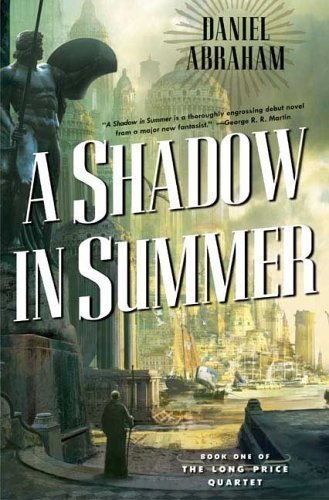
A Shadow in Summer: Now in Paperback
You can now pick up a cheap copy of Daniel Abraham's A Shadow in Summer on bookstore shelves.
I did not lust after this book with ravenous passion of a bel dame, but I did enjoy much of what he did with it. My review/rant is here.
Please support Series Fantasy That Doesn't Suck.
Monday, July 30, 2007
Sword & Sociology
As I've been ready Tobias Buckell's Ragamuffin, it's gotten me to think about what it is that makes fiction really great for me. Some of this I covered before when reviewing some of VanderMeer's work, and the same issue is hitting me again with Ragamuffin, only in the opposite way.
See, so far this is a nice action-packed little dialogue-and-fight-scenes book, and there was this big rolicking chunk of it that I really enjoyed before this current lull (I'm over halfway done now), but... there's seriously something missing for me. It's got the kick ass female protagonist, and the interesting worlds and characters who are actually not white! and not Christian! Which is great!
But.
It's falling into the same trap that I see a lot of SF books get accused of falling into, which is the: gee gosh bang wow look at all these neat ideas!
Oh, yeah, and there are these cool machine-people-superheros, but they don't really care about anyone or themselves, because they are mechanically enhanced and have very little angst.
See, the problem with creating characters who don't care about anybody and don't reflect on their lives or tell you anything about them... it's hard to love them.
I want to fall in love.
And the people, if not actual robots, end up being rather robotic, emotionally. Some of that I can get because they're weirdly old and partially mechanized, but to me, it smacks of a real conscious desire to ignore the emotional and social ramifications of these sorts of technologies (I mean, look at Carnival! Uber-tech and characters who have intense emotions and huge backstory and everything! It can be done, see). What do really old people dream about? What's their relationship with thier bodies like? What do they think about? Do they even care about people? Do they go through cathartic experiences, or is it all just one long day, and if it's just one long day, what does that *feel* like? What does it *feel* like to be retrofitted to save humanity? Do you ever get drunk and hate yourself? Actively hate yourself, not just pass it off as being "nerves"? Do you still believe in what you're doing?
Because here we have this plot clicking along, this very classic end-of-the-world-savior-from-tyranny thing, but... there's no subplot. There's no emotional core to this story. There's no emotional hero's journey, just people hopping in and out of machinery and neat ideas (which are neat, don't get me wrong). But at the end of the day, I'm getting the feeling that it's going to be one of those books I go, "Well, that was fun," and set aside and forget about. The emotional ramifications of these techologies seems to be sitting somewhere on the backburner and handwaved. Some of this issue might be because we start headhopping early on and it's a short book, so we can't really follow anybody's journey the whole way in any kind of bulk.
But.
I realize that a lot of this is just personal preference - I want to know what the protag *feels* about the fact that she gave up her womb to be a weapon for humanity (what significance is attached to this womb? Hers or her societys? You may think that's a dumb question, but if you think that, you're seriously suffering from an atrophied imagination). I want to know how it *feels* to be a clone. Is this one of those clone-belief systems where they're like robots, or where they're really like siblings? Did they grow up together? Did they laugh and play together? What did she lose when she lost them? Do mechanized people have dreams and memories? Is it really in the best interests of tech to erase or supress "non esstential" memories? What do our memories give us? Can they motivate us? What do we lose when we lose memories? No tech is perfect.
What does it mean to be a man or a woman in any of these societies? Are women "equal" or are wombs more prized and women made even more subserviant because most of humanity is subserviant to an alien race? (I would argue that, historically, you'd find that women are abused most when they're part of a slave system, because they get abuse from their masters and from the frustrated men of thier own species - or would they? And why not, if so?). This is one of those societies that does that weird handwave "well, we'll have women starship captains but we won't ever really talk about sexism" things. There's some passing references to racism, but most racism is speciesism (sp); ie humans are beasts who've recently been kinda sorta "emancipated" just like slaves after the civil war ("yeah, you're free but we own everything and you still have to work for us!").
At Clarion, somebody said what I actually write are "Sword & Sociology" stories. The magic is sort of wishy-washy whatever maybe sorta, there's lots of blood, but mainly what I'm about is how these settings created these social practices, and how these practices shaped different aspects of the society and the people in them. Beliefs about religion and women and men and honor and dignity and wombs and what it is to be a man (and if it even matters) and who's in charge and when and why and the significance of sand... that should all be in there. Your society doesn't exist outside of or removed from the technology. Everything it does, including the ways that people think and feel and the personal relationships and conflicts they get into, are going to be informed by these beliefs and practices.
But when you've got primarily dialoge and fight scenes book, awesome and exciting as those are, you end up writing a book about people that it's much more difficult to fall in love with (particularly if you head hop a lot) and who might be interesting, but not interesting enough to remember afterward because you don't spend enough time with them and don't go on an emotional journey with them.
I'm not saying that's happening with this particular book (the shrug, whatever aftereffect), cause I'm not done yet and a proper review is coming, but I have a bad feeling about it. Which really sucks, because I picked this book up and put it back down three times in the bookstore and then came back and finally bought it because I was afriad somebody else would buy it; I wanted a book about Nashara (the ass-kicking heroine), but Nashara's now cloned herself into a ship and more than half the book is now from other people's POVs, and gosh-gee-whiz-bang ideas aren't enough to keep me jumping up and down about it.
We'll see how it goes.

Why Am I So Tired?
Things are good-crazy, but that means there's a lot of work to do, and man, sometimes it makes my brain hurt.
Sunday, July 29, 2007
Ragamuffin
pg 105
"All ten of us were women, Jamar. We gave up our wombs and in return were fitted with quantum computers running intrusion devices that can overpower lamina and make it extensions of our minds. It would be like being one with your ship, but anywhere. Your mind replicates, copying itself endlessly until you have control of all it is in contact with."
He looked at her, face pained. "Your wombs?"
"I saw what happened to the other nine when they attacked the Hongguo who intercepted our ship. They destroyed the Hongguo ship, but their bodies died as they took over the Hongguo ship's lamina. It's bomb. You can't unexplode it, and when it happens, you are that lamina. You're no longer human."
Wait a minute. HAS HER WOMB BEEN REPLACED BY A BOMB? (is this the only place they could put it? A womb is not really a huge organ, you know. Did they take out her pancreas, too? Why not her pancreas? And her appendix? And half of her small intestine? Surely she lost a lot more than her womb? And why, as a clone, would she attach any significance to her womb? But then, how does their brand of cloning work? Do they birth their own clone babies in wombs or vats? This is what happens when there are big chunks of missing backstory)
Oh, you can bet I'm going to be writing up a review of this one.
One-Sentence Stories
When sharing music becomes foreplay, you know you have something beautiful.
He knows to keep an eye on my hands, as the length of my finger nails is in direct proportion to how content I am with my life.
You never wrote back, and today I stopped expecting you to.
Night after night I stare at my phone in anticipation until I realize you're too busy doing blow in strange people's houses to bother with me.
More here.
Purported American Apparel Tag
From here. Real or not, I'm still waiting for a day when this is a given, not a privilege or an employer's recruitment bargaining chip.


Saturday, July 28, 2007
Garbage In, Garbage Out
I've been working on some requested edits for God's War this week. Revising can be a hell of a lot of fun when you get feedback of the "I'd like more of this! and this! and this!!" variety. Not so fun when you get the "I'm not sure why this doesn't work, but could you make it work?" variety.
These are fun edits.
One of the biggest writing lessons I've learned over the years is that if I want to write good stuff, I need to absorb an incredible amount of media, and whenever possible, a heap of real-world traveling, socializing, listening to others' stories. And it needs to be varied. And it needs to different. And it needs to be good.
I used to think that writers and "creative" people were just these natural geniuses, and everybody else was a bigger genius than me and that's why I had to work so hard but they just pulled all this stuff out of their heads that was New! and Different! and Kewl! and they SOLD it!
It may still be true that there are wacky brain-full geniuses out there who pull this stuff out of thier asses, but what I've found is that I'm more likely to spit out stuff of the kind of quality and variety that I absorb. One of the reasons I majored in history is because I believed it would expose me to more stories than I'd get as an English major (I figured I was already reading all those books - history would force me to read different kinds of stories), and being a better writer is one of the reasons I'm a crazy credit card traveler. Traveling, for me, is like a drug. I get high on the very idea of all the great ways I can use all the material.
If I spend a lot of time reading Dragonlance novels and watching bad tv sitcoms, I'm going to write something that comes out like a bad Dragonlance novel sitcom (it may have been all very well and good to write Dragonlance back in the day, but there's nothing new or fresh about it now; if you think there is, you're probably just new to the genre, or very young).
Garbage in, garbage out.
I didn't realize how much I did this until I had somebody asking me a bunch of questions about God's War: how did I come up with the bug magic system? The setting? The holy war ideas? The word "bel dame"?
And you know, when you pick out ideas like that, I can tell you where I got them individually (as a whole, tho, I'll have to tell you it's Schenectady, of course).
The bugs came from living in South Africa in a - quite literally - coackroach-infested flat that was also full of geckos and flying ants - swarms of flying ants - on occasion. It wasn't like visiting Disneyworld where it's hot outside and maybe you see a big moth and then you go back into the air conditioned superplex. No, there was no air conditioning. There was no fake superplex (OK, there was the Gateway mall , let's be fair. But basically, there was the Gateway mall and then... everything else). Bugs were just sort of a fact of life. I'll never forget walking past this huge house one day that was covered - completely covered - from roof to sidewalk with thick plastic sheeting. The vans out front announced the fact that this house was being fumigated.
Bugs, man.
Bugs were a fact of life.
And where does "bel dame" come from? "Bel Dame" is actually an ancient word from Biblical times (Assyrian? Babylonian? I forget now) that meant a person who was hired by a family whose relative had been killed in order to apprehend the person who committed the crime and collect "blood debt" - either by killing the person or getting their family to pay the other family blood money in lieu of, well, blood. (it also is reminescent of "belle dame" - a beautiful woman or beautiful mother. And "bel dam" - an old woman or a witch). It was reading a book about the practice of ancient blood debt that gave me the foundation for the bel dames and ideas about swapping blood and organs for bread.
Everything else came from books, from media. I did a library search at the Northwestern University Library and made a list of books I was interested in; they were all about ancient Assyria, Iraq, Iran (ancient Peria), guerilla warfare, Islamic history, Islamic women, Islam in general, warfare in general. Jenn would pick these up for me from the Northwestern library ten at a time, and I'd go through them like I was writing another Master's thesis.
I started trying to teach myself Arabic. I started dying from diabetes.
I wrote the opening line for the book, "Nyx sold her womb somewhere between Punjai and Faleen, on the edge of the desert," a few weeks after I got my IUD, and was experiencing so much blood and pain that I just wanted to rip the fucking fucker out. IUD + dying of diabetes means you're going to start writing some pretty fucked up shit about the body and one's relationship to the body.
Those themes get hit even harder in book two. As do themes about loss, dependence, death, and rebuilding.
It all goes in there, one way or another. I still write down particularly witty quotes or witty plot devices from books and movies. I spent last night collecting all of the extra quotes and details and interesting characters pieces that I hadn't managed to get into the book the first time. Now, I can go through and check them all off when I've added them.
My fourth disk of Rome is now in the mail. I just finished reading A Thousand Splendid Suns, and re-reviewing In the Rose Garden of the Martyrs. I'm still hip-deep in William T Vollmann's abridged version of the classic morality-of-violence epic, Rising Up and Rising Down.
Today I picked up a copy of The Kite Runner and Ragamuffin. I'm going through my book of Insects and my book of Poisons to pull out some details about bugs and get some inspiration for fleshing out my biological weapons.
This stuff doesn't come from nowhere.
And I guess, really, it shouldn't be any surprise. What makes good writers isn't just being able to put down a sentence. If writing a good book was easy, we'd all be bestsellers and/or award winners and everybody would've finished a book and every one of them would be this wacky, unique blend of media and life experiences.
But that doesn't really happen.
I remember reading Perdido Street Station for the first time in South Africa. It wasn't, I thought, a great book. The plot was a mess and I wasn't particularly drawn to any of the characters. But it was wild and messy and fucked up, and the stuff on the page raised the bar for ideas in the genre, in fantasy, for me. Elves and swords were all very nice and good. Genocide and feudalism were fine. But this was something else. It was pushing toward that other place, that someplace that was really different.
And it's been my goal, since Clarion, to push the envelope. To take everything I do and push it just a little bit more, twist it in the opposite way that I'm inclined to twist it. I don't ever want to get charged with "a failure of the imagination" again.
If you want to keep getting better, if you want to be really different, you have to do that the whole way. You have to challenge yourself. You have to stop eating garbage. You have to pull in all the stuff you love, you admire, the stuff that twists up your head. And a lot of is, yes, a great deal of it, is going to be about you. All that emotion, all those experiences, are funnelled through you. It takes some courage. And a lot of hard work.
You can certainly make a living not doing that, but that's not the reason I got into writing genre fiction.
If I wanted to make a decent living, I would have become an investment banker.
Do I Even Want to Total Up All These Chipotle Receipts?
When the house (including the bathroom and kitchen) is busted down and out for replumbing and rewiring for a week, just how many times did I go to Chipotle?
Man, this is a big stack of receipts. I need to get back on budget.
I also need to sit down and re-budget based on my new salary. Pretty much the only change, though, should be allotting more for credit cards and less for meds...
Real Age Calculator
Even with diabetes, this odd little hippie test insists I shall live until 90.
This is mainly because all of my grandparents and great grandparents are in their 80s and 90s.
Diabetes genes + Logevity genes = me.
I have no idea what the "real age" part of this test means. Apparently, I have the body of a 10 year old. No idea.
(via jlundberg)
Friday, July 27, 2007
Ancient Egyptian Prosthetic Toe
Purely aesthetic or completely practical?
These are the thoughts that keep me up at night.

Subscribe to:
Posts (Atom)


