One of the hardest parts about writing professionally; that is, writing in the corporate world, is letting go of things you know you could do better if you just had more time.
Deadlines come hard and fast. You often don’t have enough information to work with (and sometimes you’re just making up filler with no information at all), and you have to just do your best and get it out the door.
Fiction can feel like this sometimes, too (if only I held onto this book for another 5 years, it would be PERFECT because in 5 years I’ll be BRILLIANTER!), but the last couple of books I’ve worked on, I feel I’ve made them very nearly the best they could be, at the time, with what I had to work with and what my brain would actually parse and digest (GW gets better over time with more input and of course, there are so many months between edits that I tend to improve between drafts, but each time I finish it, I nearly always feel it’s the best I could do with what I had).
Corp writing has been more and less frustrating. More because, wow, you want everything you write to sparkle, but less because this isn’t your baby, your passion, your book. At the same time, I get off on taking crap and making it all make sense. I enjoy written communication; I fall in love with words. Reading can make for great foreplay (so can writing, for that matter), and good prose is terribly sexy.
But I know that I’m getting paid to produce something smart and legible on time to deadline, and Really Great whenever I possibly can. You do the best you can with what you’ve got, and move on and don’t dwell on it. You’re getting paid to produce, not to fall in love. You’re getting paid for product, not for passion.
But I confess that I often just can’t help slugging around a bit of both.
Wednesday, August 08, 2007
Letting Go

Tuesday, August 07, 2007
Buy Me "Love"
Fantastic documentary about Japanese "host bars" where women go to pay men to entertain them (and certainly, sometimes, more).
You really should watch the whole thing. I thought the film maker did a great job exploring a number of the complexities involved in this kind of work from the perspective of the hosts and clients (one of the more interesting tidbits: 70-80% of the women who pay extravegent sums for male attention in host bars make that money workingas prostitutes. Watch these sorts of industries perpetuate themselves).
Just Bleed on Your Phone
David's been half-jokingly asking me ever since he saw my cellphone-sized glucose meter when they were going to integrate a glucose meter and a cell phone.
"Soon," I'd say.
And here it is.

Monday, August 06, 2007

Math is HARD
Daniel Abraham observes:
Ms. L suggests that Ms. M is insufficiently feminist because she is encouraging middle school girls to learn math by pointing out that being smart is not inconsistent with shopping and fashion and the consumerism that all us good lefties decry as bad and which middle school girls seem to think is just too nifty for words. If Ms. M wants to be a good role model for girls, she shouldn't do it (Ms. L suggests) by celebrating Gucci handbags....
Ms. L doesn't want math-smart girls. She wants TOTALLY LIBERATED, SELF-EMPOWERED middle-school girls RIGHT NOW, and anything less than total enlightenment is falling short. Which is great if what you want is the illusion of the moral high ground. And since that's not actually possible, it lets her off the hook for any effort toward incremental change.
True/False? Debatable? Totally on crack?
Have at it.
Condoms Beat AIDS
I mean, it's no worse than that whole guys-dressed-up-as-blobs trying to get through the gate video they showed us in third grade.
Certainly more entertaining.
Off to the Races
Despite th ankle silliness, my sugar's been pretty good the last couple of weeks. A sample from the last few days:
116
118
82
106
72
108
93
76
102
80
56
109
112
61
134
107
102
No idea how I'm doing this. A surprising lack of stress, perhaps. I mean: knowing you have health insurance is a beautiful thing.
Also, staying away from those chips at Chipotle? And toffee peanuts?
Priceless.
The Boys Found the Blog
... or, rather, I knew *somebody* at work had found the blog a couple of weeks ago because I found a second IP address sharing the same ISP as my my work IP. I waited around a bit for somebody to say something, but nobody did, so I shrugged it off.
I mean, dude, I work all day with IT guys: all one of them has to do is Google my name, and every hit that comes up is... me.
But today one of the guys came in and said something to somebody else about how he's only a year younger than me....
And my head shot up and I asked, "How did you know how old I am?" In part, I'm sure, because I was waiting to figure out who'd found the blog.
He quite happily directed everyone to brutalwomen.blogspot.com where my Ohio coworkers had their suspicions confirmed:
I am, indeed, from the left coast.
In any case, no harm, no foul. Regularly scheduled blogging here won't change, but if I have any awesome work stories, they'll all go in the locked LJ.
Hi, guys!
Sunday, August 05, 2007

The 237 Reasons to Have Sex
And, here's the list of the 237 reasons to have sex thus far recorded and tabulated for SCIENCE. Do be sure to nominate your own....
Let Your Protagonist Be Ugly
Mary Sue is a term originating in fan fiction, for a phenomenon that has probably existed since a Cro-Magnon teenager scratched a stick figure single-handedly slaying mammoths on a cave wall.
The above is a short list of stuff you can do with your characters to avoid the Mary Sue syndrome: that is, the creation of a too-perfect, too-beautiful, infallible main character who makes every reader roll their eyes. I used to think that this was stuff that other writers thought about all the time, and I noted that I had very few really beautiful protagonists because I wanted them to operate in a society where they didn't have that going for them and had to rely on wits and/or brute strength or some other characteristic. At the same time, I'd make secondary characters who were beautiful and terribly flawed, so one of their best assets was their looks, and they knew it. Beauty is a character trait that will affect how you're seen and treated in the rest of the world, just like gender, just like race, just like education and background. You have to take it into consideration.
I don't remember who I was talking to, a couple of pro or semi-pro writers, and one of them said, in conversation, "You know, actually, now that I think about, all of my protagonists are traditionally attractive."
It's not that you can't do this, of course: the Kushiel books do this. It's just that it's one more interesting thing you can put into your character's pot, one more hurdle and/or obstacle they have to overcome, one more trait.
This goes for smarts, too. I think that, as geeks, we want to create people who never fuck up, who are smarter than everybody else, who never get into situations they can't *really* get out of, and who don't have to rely on other people; just their own smarts.
I remember reading the draft of a friend's book and realizing, at the end, that every single plan that one of the characters came up with.... worked. And I don't just mean "got the result they wanted," but every single plan came off exactly like she said it would, in exactly the right way. Halfway through the book, I didn't feel any sort of tension or suspense when she put a plan into motion, because... well, they always came off without a hitch.
I like to write about characters who fuck up. Not stupid characters, mind, but characters who fuck up because they weren't well informed, or somebody was informed more than they were, or they anticipated everything but this one thing. I like putting people in a place where they fail, because seeing a character fail, and seeing how they react to that, tells you an incredible amount about them. And creates a hell of a lot of suspense.
Angst, done well, is a fantastic tool too, but angst to the point of inaction kills your book. I've read a lot of first drafts from morose, angsty, depressed writers who drink too much who then open their books with a morose, angsty, depressed hero who drinks too much. It's not like you can't *do* this (Yiddish Policeman's Union is a good example of an angsty, depressed protagonist who drinks too much, but DOES something), it's that yes, you must DO something. Your character can wallow, but they need to act, they need to move, they need to progress the narrative, and they had better be doing far more action than angst in the beginning, in particular. I'm not going to feel sorry for some angsty protagonist I just met.
Some of this is just going to be personal author preference, I know. I don't like to write about beautiful protagonists: I like to write about unattractive but driven protagonists who angst after the beautiful secondary characters. I like to write about characters who fuck up. I probably default to this because that's my experience of life, and writing it up any other way would feel dishonest. That's not to say, again, that I haven't written dumb, beautiful characters or wily, beautiful characters, because I have (indeed, those people exist too), but these aren't the stories and conflicts I'm drawn to, they're not the ones I best sympathize with.
There is, I think, certainly some wish-fulfillment in much of the fiction we all write (which is probably why all the genre writers - SF/F, thriller, romance, etc get all the shit form the literary folks who think writing about drunk writers who can't get laid in New York is somehow realer and more noteworthy than writing about hard-up interstellar bounty hunters who save the world and get laid), though it's not necessarily a wish-fulfillment embodied in the character; perhaps merely the situation. It's the idea that we can all be powerful, we can all make a difference. And what I like to show, what I like to write about, is how we can all make a difference, we can all change the world, no matter how imperfect and fucked-up we may sometimes be (other writers' mileage and motives vary wildly, but that's mine).
If my protagonist can change the world while being illiterate, wombless, only carrying around one good kidney, with three fingers on her right hand, no money to her name, a not-beautiful face, a nice ass, a bad shot, and a fair ability in a boxing ring, I mean, really, you and me - with my faulty immune system, sprained ankle, graduate education and money in the bank - we really don't have any excuses.
The Navy Does "Hey Ya"
This is probably a far more effective recruiting video than anything they've got out there now. Enjoy.
Saturday, August 04, 2007
Men & Women: Not So Different
I mean, it's like, we come from the same planet and similiar cultures and everything.
After exhaustively compiling a list of the 237 reasons why people have sex, researchers found that young men and women get intimate for mostly the same motivations.
I mean, who would have guessed that the number one reason people have sex is "Because I was attracted to the person."
Baffling, really.
What attractiveness means to different people (no matter the gender) varies quite a bit, which is why some people would argue that the title is a misnomer. I'd argue, in fact, that the title's right on. A lot of women, growing up, hear that it makes us better people to be attracted to people primarily based on how "good" they are, and men are told it's better to be attracted to people based on how "hot" the person is (socially determined standards of "attractive" of course). I think both genders factor in personality and looks, and those things influence each other to a huge degree, so sure, you're going to bed with someone cause you're attracted to them: what attraction is, what is means, varies wildly from person to person (which is why even those of us who are socially deemed "unattractive" by the media at large are still having lots of hot sex).
There were social things that were pretty unsurprising, too, like the fact that women were more likely to have sex to "please a partner" (or to say they wanted to have sex to please a partner: absolutely, there's patriarchy and coersion and etc. to deal with, but I think men are more likely to omit this or pretend it's something else, or even just more likely to refuse to have sex if they don't feel like it because of privilige, I think).
The aggrevating thing about this "study" was that they left out all the good parts. Like, women rank "wanted to give sexual partner a sexually trasmitted disease" at the bottom of their list of reasons why they have sex, but they don't say where men ranked this one (!). Why the omisson? Because it ranked #2 or because it ranked second to last? And then there's this tantalizing quote at the end:
“Originally, I thought that we exhaustively compiled the list, but now I found that there should be some added,” Meston said.
Like what? What was missing? What were the top things people wrote in? And where's a copy of the comprehensive list of 237?
Why does the AP always leave out the most interesting parts and make the huge "news" story about the "well duh" part?
Friday, August 03, 2007
Independence
Another night, another attempt at making some kind of stupidly unnecessary move as a symbol of my independence, another four hours in an emergency room.
I had a lot of time to think about my foolish symbols of independence, the unnecessary treks I make and tasks I perform in order to prove I'm not dependent on other people, on insulin, on breathing; to pretend I'm somehow unlike other people, somehow removed from everyone else.
I fought hard for my independence in my early twenties, fought to show how strong and brave and emotionless I was. I could buy one way tickets to Alaska and live in third world countries and stop dating all together for six years, because all that would prove how strong I was, how coldly unemotional, how removed from this tide of people, from the social networks that keep us alive.
I did that for a long time, and I know it was a reaction. It was a reaction to a bad relationship, where I'd depended on somebody to do stuff who was actually inept, where I'd given up too much of myself, thinking that he knew what he was doing. I lost myself slowly over those two years, and then rapidly during the six months we lived together. I tried too hard to please somebody who was really just a scared kid like me, who really didn't know much more than me. If we could have been partners, if he could have admitted weakness, maybe things would have worked out better ie not in an abusive clusterfuck way. But neither of us would owe up to the fact that he wasn't invincible, and then the whole thing fell apart, and we tore each other up.
Sometimes, people say, when you're abused, you become like the person who abused you, because you see that they had power; you, too, want to be powerful, so you emulate them. What I learned, I think, was all of the things I hated about myself. I hated my blind trust. I hated my inability to fight back. I hated the screaming, sobbing person I became during a conflict. I hated who I became in that relationship, and for years, I avoided relationships because I believed they made me weak, dependent. They would turn me into that screaming, sobbing, wreck of a woman, and I didn't want to be that. I wanted to be somebody who wrote books and bought one way plane tickets. I wanted to learn French and learn how to fight.
The diabetes thing should have been a wake up call, should have torn me back from that other place. I was still having trouble with relationships, with, I believe the complaint was, at the time, "my inability to connect" or "a lack of connection." I formed relationships in such a way that I would always be OK if I stepped away from them. I made sure I didn't rely on them for anything: for money, for emotional support, for a trip to the bank. When you relied on people, it made you weak. People let you down. People weren't perfect.
But it was Jenn who saved my life and found me in a coma and called 911, and Jenn who sat with me two nights in the ICU, sleeping on two chairs pushed together, holding my hand every time they dug into my veins looking for a line. It was Jenn who cut things for me when I came home too sore to move my hands, and Jenn who offered me everything, anything, whatever I needed.
This was love.
But to me, it was dependence. I pushed it away. I railed against it. I had to prove I was strong, prove I was still me, prove that I could do anything. I could fly.
Obviously, there were other issues involved, but that was a big one I was dealing with, one I was unable to deal with. I'd spent so long working so hard at not relying on other people that to not only have that freely offered, but to actually, in fact, sometimes really need that.... it was devastating. It was heartbreaking. It shook the core of who I was, who'd I'd become, what I'd made of myself.
I didn't know who I'd be anymore, if I wasn't this woman I'd built.
I lost a friend in part because of my inability to depend on others, to accept love and affection and just plain friendship, but that wasn't enough. No, I couldn't inconvenience people. I had to prove I was strong.
It took a harrowing, horrible situation in Chicago to make me accept Steph & the Old Man's offer to stay here in Dayton. Things had to spiral into some kind of chaotic nightmare, and telling you how ingrained this idea was in me - this idea that I should not count on or rely on others - and yet, I moved to Dayton anyway, tells you how bad things had gotten in Chicago.
By accepting the offer, I hoped I was making some progress. Here I was accepting kindness, relying on others for a roof over my head. But no, I had to continue to do needless, stupid things, like not ask for rides to places they could easily take me and map out convoluted bus routes instead. Refuse to "inconvenience" them by asking for a trip to the grocery store because really, I could get most everything on my bike, and I didn't really *need* any pop or anything really heavy. If everyone was home, I didn't *need* to work out in the living room. If everyone was around, I didn't *need* to eat with them, because I was independent. I'm strong. I can do anything.
And tonight I came home, and, me being me, I needed a copy of The 300. Because I'm me, and it's payday. There's a Wal-Mart three miles down the street, but I didn't want to bike there because I wanted to pick up a book shelf for my pony mods, too. Steph was home, but she was visiting with her mother and sister in law, and you know, I didn't want to inconvenience anyone. I didn't want to get in the way.
So instead of asking Stephanie for a ride down the street to get the shelf, I took a half hour bus ride down south to the Dayton Mall. I wandered around the way-out-there Wal-Mart, lost track of time, and stood in a big ass line with my movie, waiting to check out, realizing I wouldn't have time to get the shelf anyway. By the time I finished the transaction, I had four minutes to make the next bus.
I ran. I bolted out of the store and I ran like mad, because, this being Dayton, the next bus wasn't for an hour and a half, and me being me, I wasn't going to call Steph or the Old Man to come pick me up because I'd missed the bus. I would have to find something to do for an hour and a half, and it was Friday night, and I just wanted to get home.
Within sight of the bus station, I tripped over the curb and went down hard.
I rolled my right ankle and came up wincing. One look down, and I knew something was very wrong.
There was a fist-sized swelling on my right ankle.
Well, fuck.
I limped the rest of the way to the bus station and propped my leg up. I started getting those rolling waves of black flashes across my vision. I wanted to throw up. I thought I was going to pass out. My ankle kept swelling.
I called Stephanie as my bus pulled up and told her to come and get me and haul me over to the Miami Valley emergency room.
And when Stephanie and the Old Man arrived, the first thing Stephanie said, of course, with a sigh, was, "You realize we would have come and picked you up if you missed this bus."
Yes. Of course I knew that.
But I didn't want to rely on them. I didn't want to inconvenience anyone. I wanted to be strong and independent.
But I'm an insulin-dependent diabetic. This desire makes no logical sense anymore. I can't pretend I wouldn't die without insulin. I can't pretend I won't die without other people to make that insulin, and the other tools I need to survive. But I can try and make myself less of a burden. I can try and be strong.
But these days, all my attempts to be strong just end up being attempts at being stupid.
And there I was, lying once again in a hospital bed in the Miami Valley emergency room, waiting for the X-ray results to come in, thinking about how lessons are repeated until they're learned.
Tonight, I learned how to be a funny patient. I joked with the staff and was loud and gregarious when I was not hobbling or haggling with the security people who delayed my progress. The X-ray tech was hot, and I waxed on with the billing clerk about what it's like being a document writer for a tax company. He remembered me from my last visit to this emergency room, and we joked about suing the RTA.
Hospitals, at some point, become terribly funny, because once something is done, it cannot be undone. Once you make a decision, a foolish action, you must live with it.
And you must learn from it.
Because if you don't, it will be repeated.
I stared down at the fist-sized swelling on my ankle and thought about surgery, about broken bones, about half a dozen bad possibilities. I prepared for those while the Old Man waited for me out in the waiting room as the hours of his Friday night ticked by.
A nurse swung by and gave me some vicodin.
The friendly, boisterous doctor showed up with the X-ray results and exclaimed:
"It's not broken!"
"It's not?" I said, with a great rush of breath, an enormous sense of relief. Another tragedy averted. Another foolish warning given.
"You've severely sprained it, though," he said. "You've chipped some of the bone on that knobby bone here on the inside of your ankle. Sometimes severe swelling is good, because it means you took most of the strain on your tendons and all the fleshy bits here."
Thank god for the fleshy bits.
"We'll set you up with an air cast you can strap on and take off for showerings, but you'll need to be on crutches for a week. Here's a prescription for some more vicodin and a doctor to call for a follow-up appointment."
Not broken.
No surgery. No blood. No needles. No months lugging around a clunky cast. No crutches in Switzerland.
Sometimes I have to stop and wonder why I'm so lucky.
"Thank you," I said.
And as I made my way back into the waiting room, there was the Old Man waiting for me, saying, "So you didn't die? Too bad. I wanted all your stuff!" because he knows, more than anybody else here, how you deal with the never ending fight with your body, with the world, with failure and rebirth:
Humor and sarcasm.
I am so lucky.
When I came home and sat down with Stephanie and her mother-in-law at the table, I owed up to it, I told them, "I know this is a lesson. I know it'll happen again unless I learn it."
"People need people," Steph's mother-in-law said. "It's really OK. It's how we survive. We need each other."
But I don't want to need anything. I don't want anyone to need me. I want something else, some phantom strength; I want to be a superhero.
But the person I want to be isn't human.
I went to bed and rearranged everything and made sure the laptop extension cord can reach the bed and put the phone next to me and the hard candy near by and settled in for a long weekend of meals in bed and writing.
Writing in a world about a woman who thinks she lives, somehow, outside of the world, apart from it, a woman who believes she can live without love, while her body breaks down around her.
At least I have no illusions about where my core emotional story arcs come from.
There's not much else to think about when you're staring at the ceiling in the emergency room.
Except maybe that hot X-ray tech.
And my surprising ability to squeeze out just one more breath of life, just a little bit longer.
Overdosing
8 + 8 would be 16, not 32.
Which would mean one unit of insulin, not two.
This is why you should never work and shoot up at the same time...
Thursday, August 02, 2007
Life
I've been living and breathing God's War edits for the last week and subsisting primarily on Chipotle burritoes and working internet-distraction-free at the local Books&Co.
Seriously, living and breathing edits. I write work-related stuff all day and do edits on my own time, come home, work out, bike to Chipotle, bike to Books&Co and write all night.
Yo ho a writer's life for me.
My brain feels like a wrung-out sponge. I've added fifty pages of new text and cleaned up some dodgy scenes. It's a better book. I read the end of a scene tonight and nearly cried, whether because the book's so damn good that I feel for the character in a way I didn't before, or just because I've been so immersed in this damn thing that I couldn't help getting a little weepy at all the pathos cause I'm spending more time with these people than I am with people in real life.
Either way:
Yo ho.
Ragamuffin (Redux)
Man, I wanted to love this book. Really, really wanted to love this book.
I hadn’t read any of Buckell’s stuff before, but I’d heard about it; it sounded like a great concept: space opera with a cast of characters with Caribbean heritage. I mean, dreadlocks and big guns and ships with awesome names like the Starfunk Ayatollah (the fucking STARFUNK AYTOLLAH! Seriously. It was great). I mean, really, it shouldn’t get much better than that.
I picked up Ragamuffin because of the lead character. It opens with Nashara, a kick-ass female heroine with no qualms about randomly killing people as necessary. She lives in a planetary society linked by wormhole technology and humans on most worlds are ruled over by the “Satrapy,” mind-controlling alien creatures who bend other races – including humans – to their will. Humans have, officially, been “emancipated,” but just like emancipation for slaves after the civil war, it’s a shallow, paper emancipation, and most human beings still live on worlds where they’re second-class, ghettoized citizens. All human-created technology is outlawed, and anybody ferrying it is killed.
Nashara just so happens to be from a world that’s created some human technology, a sort of virus she’s got in her head. When her world was cut off from the network of wormholes for their rebellion against the aliens, she and nine clones just like her were created, upgraded with tech and implanted with this computer virus, and sent out into the stars to get the tech to the people on another world. Nashara’s sisters, we learn, sacrificed themselves so she could get away when they were intercepted, and she’s been planet-hopping through the wormholes to get to the right planet. The planet’s the sort of home world, best I could tell, of the Ragamuffins, a group of interstellar pirates with aforementioned Caribbean heritage. Or, one of the sort of homeworlds. Or something. Yes, some of the history is confusing.
The first half of this book was pretty satisfying, especially the breakneck battle to get Nashara and some Ragamuffins she’d bumped into through a ship full of mind-controlled humans to save a girl with knowledge of the station and steal a starship and then flee with the starship from a group of folks doing the dirty work of the mind-controlling aliens who’ve decided that humans are tricky bastards and need to be wiped out of the wormhole system all together, not just cut off when they rebel.
The second half of the book jumps back to the planet Nashara’s trying to get to, the one that’s been cut off, a society full of Azteca (yes, the society is just what it sounds like) who also happen to have some older humans around of Ragamuffin descent who have actual tech in their heads from three hundred years before, when they were cut off from the wormhole. There’s negotiations going on between the two major countries, which are rudely interrupted when one of the wormholes suddenly re-opens and the alien race that had once warred with them returns.
Now, OK, I was having some issue with this book before, but when we abruptly shifted from mostly-Nashara’s POV and worldview to totally these other people in Azteca land’s worldview, it was like I was starting the whole book over again. I felt myself suffering from the old George R.R. Martin syndrome, ie “But I don’t *care* about any of these characters. Where are all the characters I was starting to sympathize with?”
It felt like two entirely different books. In longer books, you might be able to get away with this, but Ragamuffin is a quick, short book with short, sharp chapters. There were times when it felt like I was reading an outline for a series. I mean, it’s all about the attempted genocide of the human race. Sure, you can do that in a book, but it’s really hard to read a book with so little time in so many characters’ heads and still care about the outcome.
And when Nashara literally loses and leaves her body, effectively dies, in order to perpetuate copies of herself on other ships…. When your strong female lead who you’re already trying really hard not to be annoyed with for being a clone (Oh, those female hive minds!), ends up copy after copy after copy on other ships, becomes ships, becomes a virus, well… I have a strong aversion to the women-as-robots cliché. Sure, lots of people in this universe are technologically hopped up, but even the grizzled old meshed-out captain of the dying ship she first hitches a ride on breaks down and cries there toward the end, and he still has a physical body that can be killed and obliterated. I guess Nashara does too, sort of, there at the end, but it really wouldn’t matter because she’s mostly just projecting herself everywhere anyway. Her brain is somewhere else, not actually in her body. She’s sort of severed and cut in half, half a person. It bugged me. There’s something less human about someone who cannot die. I can’t explain it. Perhaps that’s another post.
And this brings up another issue, which is that the issue of women and emancipation isn’t discussed… at all. Women are assumed equal (really? When all humans are slaves, women are considered *equal* slaves, even though they have very lucrative wombs?), but again, looking at the place of women in oppressed societies, and having some background studying the role of women in a lot of guerilla movements, it’s not like those issues go away even among the rebels, they’re just subsumed by the larger cause. You don’t talk about sexism and the fact that your commander keeps demanding sex from you because you’re all “comrades” and you’re not supposed to rock the boat. It’s race emancipation first, and once that happens, women are going to get kicked back into the kitchen every time unless they fight like hell for it, because you might be “comrades” during the war, but after the war, you’re still just a woman.
Those issues weren’t in here much, and they don’t show up much in any book that assumes the “all women are equal, natch” philosophy (there’s one weird moment of sexism where somebody says something to the effect of “and you’re siding with that *woman*” like woman is a derogatory term, a curse word, less than man, just as we use it today. It was actually jarring because there’s really not much else in there. Nashara is regarded differently, once, because of her skin color, but not that I can recall, because of her gender).
I don’t think we actually know what equality *looks* like, so we brush the actual issues that would be involved in equality under the table and handwave it. There are a couple of references to Nashara’s womb – the fact that it was taken out in order to make room for all of her mechanical tech, and the fact that she doesn’t have one so can’t “settle down and make babies” (a statement made, tongue-in-cheek, by another character, but never expanded on). Does she even *want* to “make babies”? Do women even make babies anymore, or do they breed them in jars? I mean, they have clones. Are the cloned embryos just implanted into women (and, again, doesn’t this make women for valuable and therefore make people want to control them more)? Did they take Nashara’s womb out and save it in a jar to make it part of the breeding program? Does she even care? If this organ is actually significant (it does come up in conversation twice), what’s the significance? Is physically reproducing an important thing to mechanically enhanced people who’ll live, basically, forever?
I’m picking on the womb issues here, but it’s sort of representative, I think, of thinking through the way that a society’s social mores work and how technology effects and changes and informs those cultural mores.
In a break-neck pace book like this, you barely get enough time to sympathize or get to know any of the characters at all, let alone understand their cultures, which is a serious shame because, again, Caribbean-heritage society! I mean, how cool? But that’s not explored much in depth, either. They speak differently and you see bits of a burial ceremony, and they make decisions by consensus, but the actual way they live and breathe and work is sort of missing, here, because the plot gets in the way (!).
Stories about genocide and alien masters and gun-running and awesome ship battles are great, but in a book this size, I think the cast needed to be pared down and the chapters should have alternated between the Azteca world and Nashara’s stuff with more regularity right up front to help that sort of stop/start of getting-to-know you time. Dividing it in two made it feel like two books. You can get away with a late-start POV/world change in a longer book, but getting there and staying there for a hundred pages when the book is, what, 300 pages? Is a stretch.
I’ve heard older writers (usually midlist, but anyway) complain that the media and marketing machine is obsessed with “new” writers and “young” writers and gives them all of the attention while ignoring the midlisters’ work. I can understand some of the salivating expectation people have for newer writers, because new writers bring fresh voices and ideas with them. However, what we’re not so good at is stuff like plot, pacing, the nitty-gritty details of story, of how to write an emotional arc, how to flesh out a world or a character.
This is stuff that it takes a long time to learn, bashing your head against the desk everyday and writing book after book. You write a few books, you start to get it down, and it’s why I look at writers like Buckell and others who have all this great stuff, this great potential, these great ideas and unique voices and I think, “You know, after he writes about three more books, he could really kick some ass.”
However, the reason some more experienced writers end up getting the cold shoulder is because they *don’t* get better with each subsequent book. They go, “Hey, this book sold as is! I’ll keep writing books just like this!”
And then they’re pissed off because readers and the media machine don’t pay any attention to them.
These are the ones you run from like the plague.
But something tells me Buckell won’t be one of those plague-writers.
To sum up: not the technically best book in the world, but stay tuned for future stuff.

Wednesday, August 01, 2007
Tuesday, July 31, 2007
Why Writing Colorblind Is Writing White (a rant)
As a writer, you may write colorblind. You may pull out all the color and race and cultural tags for every single one of your characters, and thereby prove that they could be of any race!
Sure. Let's go with that. Nobody in your book has a skin color, or any sort of physical description at all.
You really believe your reader's not givng your characters a physical description? You think that one of the first markers they make, after size and gender, won't be color? Pigment? One of the first things we, as largely visual creatures, fixate on in order to tell one person from another in a culturally diverse society (if everyone's the same color, no, we won't fixate on that as much; then it becomes about size and hair cuts and clothes, but if your society isn't monochrome, we're going to see color. Is your society monochrome?)
Come now.
Let's leave aside the fact that by ignoring a character's race, you're choosing not to deal with a lot of the potential conflicts inherent in a story where you have people of wildly different backgrounds coming together. And by "race" I don't just mean looks, either. I don't just mean pigmentation, though that's a marker we all fixate on because it's one of the most easily perceived, right there next to clothing choices (hence, burquas and veils, top hats for "gentlemen," wearing beards, turbans, kippahs, etc).
Clothing choices, of course, are *choices.* Cultural practices, except perhaps circumcision and tribal scarification, can be cast off by those trying to "fit in" with the predominate culture.
Permanenent things like color, hair type, any sort of ritual scarring or permanent body modification like footbinding, etc., cannot.
I'm going to say that again:
You can't take away these cultural markers, this indicators of uniqueness, of culture, of ethnicity, of "difference" (or "sameness" if the culture is in the majority). More than that:
You can't take away what these things mean within a society (barring long, long years of progressive work to change stereotypes or the actual political or social position of people who share these characteristics).
The great thing about being a writer who chooses to "write colorblind" is that you can totally wipe your hands of all responsibility. Just like this (I realize I'm being harsh on Scalzi here, but this pissed me off). I mean, you're not being racist. The world in your head is totally diverse! It's your readers who are racist if all they see is pale people (or dark people, or polka dotted people)!
Scalzi's situation may be unique, or made purposely unique, by the sort of world he works in. He says that in the Old Man's War universe, race doesn't matter that much. He seems to be positing that happy colorblind utopia we're all gunning for, and that a lot of people seem to think we actually live in ("Oh, ha ha, I just don't see race! Or gender! I just see people! I'm a humanist!" You're full of shit).
The problem with writing in "race-neutral" (what is that? Gray? Beige?) terms is you get the same problem you run into when you write in gender-neutral terms. As people raised in a racist, sexist, society, we're going to norm a lot of stories, a lot of people, as white males. There are certainly ways you can code this differently, and every reader brings their own unique set of indicators to the reading experience, but I think the vast majority of people are going to sit down and code your world in whitewash unless they get some indication that it's otherwise or they bring something non-majority to the table.
We have a default setting we've been programmed with, and it's the default setting we've been pumped full of since birth: stories about bands of white brothers, fathers and sons, heroic male conquerors, Columbus, rich white presidents, men of Science, great white male writers; the men who run the world are white. The important people are white. We're reading about important people, right? Unless we're reading some kind of hippie women's story set in some jungle where people don't speak plain English.
Am I exaggerating? Very slightly. Certainly we learn about women. Marie Curie (quick, tell me what time period she lived in? No?). Virginia Wolf. Indira Ghandi. The Girl in that movie. You know, The Girl in every movie? Come on, you know her so well. She's that *one* girl in *every* movie that's chockfull of 10 male main characters and a slew of male secondary characters and some female prostitutes for the drug scene. You know, The Girl.
But these are presented to us as exceptions. "Oh yes, there were these people too." (there was "the Girl). In February you learn, "Oh yes, there are these black people too." (usually it is "The Black Person," ie Martin Luther King)
To be honest, I still know more about Columbus and the heroic Pilgrims than I do about whatever tribe it is helped the Pilgrims not starve to death. No, I don't even know the name of the tribe (did it start with a P?), but I could tell you the ships the heroic pilgrims sailed on.
Sure, I could look it up, but I'm talking about knee-jerk knowledge, knowledge so deep it's become part of your subconscious, the stuff you learn by rote and exposure and have seen so much that it's become unexamined truth.
These are historic holes, ways we view the world, that have been shaped by race and cultural and power and gender. The race and gender and rich land-owning elite in charge (I recently learned that some of the first US taxes were lobbied heavily by landowners on a number of everyday goods in order to keep the government from taxing land) determine what we care about and what's important. We can fight against that, and learn more, and question everything, but we have to fight those unexamined truths every goddamn day.
I would love to ignore all of this stuff. I would love to pretend it didn't exist. I would love to say it's easy for me to write a matriarchal society where every single secondary character's pronoun comes out smoothly and easily as "she." I would love to say that I don't have to keep a running tally of how many times I try to use the word "pale" when describing main characters who really don't get all that pale(r), or that I don't have to keep a check on how many characters in my primarily brown-and-black world end up disturbingly pale.
Yes, it gets easier to do, over time. You code new paths through. You make new realities.
But first you have to question and breakdown and challenge the old ones.
And you're not going to do that by shrugging and telling yourself you're just writing a monochrome world.
I suppose, of course, I could just ignore everyone's hair type and skin color and cultural practices and pretend they live in a whitewash world where everyone is colorblind (which really means "Everyone is white."). But if I ignore that, I ignore the history of these people. I ignore the struggles that they have with one another and with other people; other cultures. I ignore historical disputes and historical differences. I ignore the fact that certain foods are taboo to some people and loved by others, so they can all eat happily together without commenting on it. I lose conflict. I lose richness. I lose truth. Nobody thinks somebody else is going to blow up a building or try and mug them or must be a member of the ruling class based entirely on the food they're eating, the way they wear their hair, or the color of their skin.
Perhaps it's easier to write a world this way, no doubt. No doubt it's a much easier world to live in. But it feels to me like a very fake sort of world, a very lackluster, colorless world.
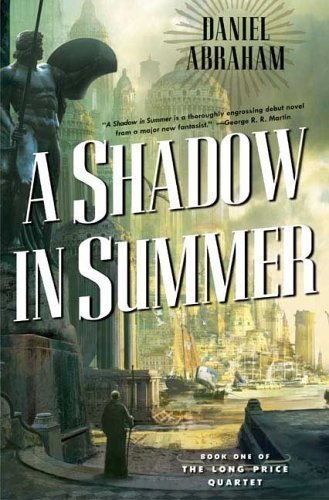
A Shadow in Summer: Now in Paperback
You can now pick up a cheap copy of Daniel Abraham's A Shadow in Summer on bookstore shelves.
I did not lust after this book with ravenous passion of a bel dame, but I did enjoy much of what he did with it. My review/rant is here.
Please support Series Fantasy That Doesn't Suck.
Monday, July 30, 2007
Sword & Sociology
As I've been ready Tobias Buckell's Ragamuffin, it's gotten me to think about what it is that makes fiction really great for me. Some of this I covered before when reviewing some of VanderMeer's work, and the same issue is hitting me again with Ragamuffin, only in the opposite way.
See, so far this is a nice action-packed little dialogue-and-fight-scenes book, and there was this big rolicking chunk of it that I really enjoyed before this current lull (I'm over halfway done now), but... there's seriously something missing for me. It's got the kick ass female protagonist, and the interesting worlds and characters who are actually not white! and not Christian! Which is great!
But.
It's falling into the same trap that I see a lot of SF books get accused of falling into, which is the: gee gosh bang wow look at all these neat ideas!
Oh, yeah, and there are these cool machine-people-superheros, but they don't really care about anyone or themselves, because they are mechanically enhanced and have very little angst.
See, the problem with creating characters who don't care about anybody and don't reflect on their lives or tell you anything about them... it's hard to love them.
I want to fall in love.
And the people, if not actual robots, end up being rather robotic, emotionally. Some of that I can get because they're weirdly old and partially mechanized, but to me, it smacks of a real conscious desire to ignore the emotional and social ramifications of these sorts of technologies (I mean, look at Carnival! Uber-tech and characters who have intense emotions and huge backstory and everything! It can be done, see). What do really old people dream about? What's their relationship with thier bodies like? What do they think about? Do they even care about people? Do they go through cathartic experiences, or is it all just one long day, and if it's just one long day, what does that *feel* like? What does it *feel* like to be retrofitted to save humanity? Do you ever get drunk and hate yourself? Actively hate yourself, not just pass it off as being "nerves"? Do you still believe in what you're doing?
Because here we have this plot clicking along, this very classic end-of-the-world-savior-from-tyranny thing, but... there's no subplot. There's no emotional core to this story. There's no emotional hero's journey, just people hopping in and out of machinery and neat ideas (which are neat, don't get me wrong). But at the end of the day, I'm getting the feeling that it's going to be one of those books I go, "Well, that was fun," and set aside and forget about. The emotional ramifications of these techologies seems to be sitting somewhere on the backburner and handwaved. Some of this issue might be because we start headhopping early on and it's a short book, so we can't really follow anybody's journey the whole way in any kind of bulk.
But.
I realize that a lot of this is just personal preference - I want to know what the protag *feels* about the fact that she gave up her womb to be a weapon for humanity (what significance is attached to this womb? Hers or her societys? You may think that's a dumb question, but if you think that, you're seriously suffering from an atrophied imagination). I want to know how it *feels* to be a clone. Is this one of those clone-belief systems where they're like robots, or where they're really like siblings? Did they grow up together? Did they laugh and play together? What did she lose when she lost them? Do mechanized people have dreams and memories? Is it really in the best interests of tech to erase or supress "non esstential" memories? What do our memories give us? Can they motivate us? What do we lose when we lose memories? No tech is perfect.
What does it mean to be a man or a woman in any of these societies? Are women "equal" or are wombs more prized and women made even more subserviant because most of humanity is subserviant to an alien race? (I would argue that, historically, you'd find that women are abused most when they're part of a slave system, because they get abuse from their masters and from the frustrated men of thier own species - or would they? And why not, if so?). This is one of those societies that does that weird handwave "well, we'll have women starship captains but we won't ever really talk about sexism" things. There's some passing references to racism, but most racism is speciesism (sp); ie humans are beasts who've recently been kinda sorta "emancipated" just like slaves after the civil war ("yeah, you're free but we own everything and you still have to work for us!").
At Clarion, somebody said what I actually write are "Sword & Sociology" stories. The magic is sort of wishy-washy whatever maybe sorta, there's lots of blood, but mainly what I'm about is how these settings created these social practices, and how these practices shaped different aspects of the society and the people in them. Beliefs about religion and women and men and honor and dignity and wombs and what it is to be a man (and if it even matters) and who's in charge and when and why and the significance of sand... that should all be in there. Your society doesn't exist outside of or removed from the technology. Everything it does, including the ways that people think and feel and the personal relationships and conflicts they get into, are going to be informed by these beliefs and practices.
But when you've got primarily dialoge and fight scenes book, awesome and exciting as those are, you end up writing a book about people that it's much more difficult to fall in love with (particularly if you head hop a lot) and who might be interesting, but not interesting enough to remember afterward because you don't spend enough time with them and don't go on an emotional journey with them.
I'm not saying that's happening with this particular book (the shrug, whatever aftereffect), cause I'm not done yet and a proper review is coming, but I have a bad feeling about it. Which really sucks, because I picked this book up and put it back down three times in the bookstore and then came back and finally bought it because I was afriad somebody else would buy it; I wanted a book about Nashara (the ass-kicking heroine), but Nashara's now cloned herself into a ship and more than half the book is now from other people's POVs, and gosh-gee-whiz-bang ideas aren't enough to keep me jumping up and down about it.
We'll see how it goes.

Why Am I So Tired?
Things are good-crazy, but that means there's a lot of work to do, and man, sometimes it makes my brain hurt.
Sunday, July 29, 2007
Ragamuffin
pg 105
"All ten of us were women, Jamar. We gave up our wombs and in return were fitted with quantum computers running intrusion devices that can overpower lamina and make it extensions of our minds. It would be like being one with your ship, but anywhere. Your mind replicates, copying itself endlessly until you have control of all it is in contact with."
He looked at her, face pained. "Your wombs?"
"I saw what happened to the other nine when they attacked the Hongguo who intercepted our ship. They destroyed the Hongguo ship, but their bodies died as they took over the Hongguo ship's lamina. It's bomb. You can't unexplode it, and when it happens, you are that lamina. You're no longer human."
Wait a minute. HAS HER WOMB BEEN REPLACED BY A BOMB? (is this the only place they could put it? A womb is not really a huge organ, you know. Did they take out her pancreas, too? Why not her pancreas? And her appendix? And half of her small intestine? Surely she lost a lot more than her womb? And why, as a clone, would she attach any significance to her womb? But then, how does their brand of cloning work? Do they birth their own clone babies in wombs or vats? This is what happens when there are big chunks of missing backstory)
Oh, you can bet I'm going to be writing up a review of this one.
One-Sentence Stories
When sharing music becomes foreplay, you know you have something beautiful.
He knows to keep an eye on my hands, as the length of my finger nails is in direct proportion to how content I am with my life.
You never wrote back, and today I stopped expecting you to.
Night after night I stare at my phone in anticipation until I realize you're too busy doing blow in strange people's houses to bother with me.
More here.
Purported American Apparel Tag
From here. Real or not, I'm still waiting for a day when this is a given, not a privilege or an employer's recruitment bargaining chip.


Saturday, July 28, 2007
Garbage In, Garbage Out
I've been working on some requested edits for God's War this week. Revising can be a hell of a lot of fun when you get feedback of the "I'd like more of this! and this! and this!!" variety. Not so fun when you get the "I'm not sure why this doesn't work, but could you make it work?" variety.
These are fun edits.
One of the biggest writing lessons I've learned over the years is that if I want to write good stuff, I need to absorb an incredible amount of media, and whenever possible, a heap of real-world traveling, socializing, listening to others' stories. And it needs to be varied. And it needs to different. And it needs to be good.
I used to think that writers and "creative" people were just these natural geniuses, and everybody else was a bigger genius than me and that's why I had to work so hard but they just pulled all this stuff out of their heads that was New! and Different! and Kewl! and they SOLD it!
It may still be true that there are wacky brain-full geniuses out there who pull this stuff out of thier asses, but what I've found is that I'm more likely to spit out stuff of the kind of quality and variety that I absorb. One of the reasons I majored in history is because I believed it would expose me to more stories than I'd get as an English major (I figured I was already reading all those books - history would force me to read different kinds of stories), and being a better writer is one of the reasons I'm a crazy credit card traveler. Traveling, for me, is like a drug. I get high on the very idea of all the great ways I can use all the material.
If I spend a lot of time reading Dragonlance novels and watching bad tv sitcoms, I'm going to write something that comes out like a bad Dragonlance novel sitcom (it may have been all very well and good to write Dragonlance back in the day, but there's nothing new or fresh about it now; if you think there is, you're probably just new to the genre, or very young).
Garbage in, garbage out.
I didn't realize how much I did this until I had somebody asking me a bunch of questions about God's War: how did I come up with the bug magic system? The setting? The holy war ideas? The word "bel dame"?
And you know, when you pick out ideas like that, I can tell you where I got them individually (as a whole, tho, I'll have to tell you it's Schenectady, of course).
The bugs came from living in South Africa in a - quite literally - coackroach-infested flat that was also full of geckos and flying ants - swarms of flying ants - on occasion. It wasn't like visiting Disneyworld where it's hot outside and maybe you see a big moth and then you go back into the air conditioned superplex. No, there was no air conditioning. There was no fake superplex (OK, there was the Gateway mall , let's be fair. But basically, there was the Gateway mall and then... everything else). Bugs were just sort of a fact of life. I'll never forget walking past this huge house one day that was covered - completely covered - from roof to sidewalk with thick plastic sheeting. The vans out front announced the fact that this house was being fumigated.
Bugs, man.
Bugs were a fact of life.
And where does "bel dame" come from? "Bel Dame" is actually an ancient word from Biblical times (Assyrian? Babylonian? I forget now) that meant a person who was hired by a family whose relative had been killed in order to apprehend the person who committed the crime and collect "blood debt" - either by killing the person or getting their family to pay the other family blood money in lieu of, well, blood. (it also is reminescent of "belle dame" - a beautiful woman or beautiful mother. And "bel dam" - an old woman or a witch). It was reading a book about the practice of ancient blood debt that gave me the foundation for the bel dames and ideas about swapping blood and organs for bread.
Everything else came from books, from media. I did a library search at the Northwestern University Library and made a list of books I was interested in; they were all about ancient Assyria, Iraq, Iran (ancient Peria), guerilla warfare, Islamic history, Islamic women, Islam in general, warfare in general. Jenn would pick these up for me from the Northwestern library ten at a time, and I'd go through them like I was writing another Master's thesis.
I started trying to teach myself Arabic. I started dying from diabetes.
I wrote the opening line for the book, "Nyx sold her womb somewhere between Punjai and Faleen, on the edge of the desert," a few weeks after I got my IUD, and was experiencing so much blood and pain that I just wanted to rip the fucking fucker out. IUD + dying of diabetes means you're going to start writing some pretty fucked up shit about the body and one's relationship to the body.
Those themes get hit even harder in book two. As do themes about loss, dependence, death, and rebuilding.
It all goes in there, one way or another. I still write down particularly witty quotes or witty plot devices from books and movies. I spent last night collecting all of the extra quotes and details and interesting characters pieces that I hadn't managed to get into the book the first time. Now, I can go through and check them all off when I've added them.
My fourth disk of Rome is now in the mail. I just finished reading A Thousand Splendid Suns, and re-reviewing In the Rose Garden of the Martyrs. I'm still hip-deep in William T Vollmann's abridged version of the classic morality-of-violence epic, Rising Up and Rising Down.
Today I picked up a copy of The Kite Runner and Ragamuffin. I'm going through my book of Insects and my book of Poisons to pull out some details about bugs and get some inspiration for fleshing out my biological weapons.
This stuff doesn't come from nowhere.
And I guess, really, it shouldn't be any surprise. What makes good writers isn't just being able to put down a sentence. If writing a good book was easy, we'd all be bestsellers and/or award winners and everybody would've finished a book and every one of them would be this wacky, unique blend of media and life experiences.
But that doesn't really happen.
I remember reading Perdido Street Station for the first time in South Africa. It wasn't, I thought, a great book. The plot was a mess and I wasn't particularly drawn to any of the characters. But it was wild and messy and fucked up, and the stuff on the page raised the bar for ideas in the genre, in fantasy, for me. Elves and swords were all very nice and good. Genocide and feudalism were fine. But this was something else. It was pushing toward that other place, that someplace that was really different.
And it's been my goal, since Clarion, to push the envelope. To take everything I do and push it just a little bit more, twist it in the opposite way that I'm inclined to twist it. I don't ever want to get charged with "a failure of the imagination" again.
If you want to keep getting better, if you want to be really different, you have to do that the whole way. You have to challenge yourself. You have to stop eating garbage. You have to pull in all the stuff you love, you admire, the stuff that twists up your head. And a lot of is, yes, a great deal of it, is going to be about you. All that emotion, all those experiences, are funnelled through you. It takes some courage. And a lot of hard work.
You can certainly make a living not doing that, but that's not the reason I got into writing genre fiction.
If I wanted to make a decent living, I would have become an investment banker.
Do I Even Want to Total Up All These Chipotle Receipts?
When the house (including the bathroom and kitchen) is busted down and out for replumbing and rewiring for a week, just how many times did I go to Chipotle?
Man, this is a big stack of receipts. I need to get back on budget.
I also need to sit down and re-budget based on my new salary. Pretty much the only change, though, should be allotting more for credit cards and less for meds...
Real Age Calculator
Even with diabetes, this odd little hippie test insists I shall live until 90.
This is mainly because all of my grandparents and great grandparents are in their 80s and 90s.
Diabetes genes + Logevity genes = me.
I have no idea what the "real age" part of this test means. Apparently, I have the body of a 10 year old. No idea.
(via jlundberg)
Friday, July 27, 2007
Ancient Egyptian Prosthetic Toe
Purely aesthetic or completely practical?
These are the thoughts that keep me up at night.

Thursday, July 26, 2007
Becoming Insurance Savvy
I know nothing about insurance. Really, nothing. My crash course in how my insurance actually worked was my second day in the hospital, after having come out of a coma 24 hours before, when a woman from the hospital’s billing department called me and asked what my insurance information was. At that point, I couldn’t feel my feed and my head still felt like it was, literally, full of molasses. Luckily, Jenn had my wallet handy, and I read my information to them over the phone.
A woman with a clipboard was back the next day, while I sat in a puddle of urine from a leaking catheter and a smear of my own blood because my period has started, and said, “You do know that you have a rather high deductible. Can you pay us something right now?”
“Sure,” I said. But I think that at that point, Jenn and the wallet had left, and I was on my own, and I figured I would pay part of that to shut them the hell up as soon as I got the bill.
Because I’d never bothered to submit any of my receipts to my insurance provider. With a $2500 deductible, you just figure you’ve got exactly what I had: catastrophic insurance. Something that’s only useful if you get hit by a shovel, but everyday stuff, all of my antibiotics and gyno costs and birth control costs and the doctor’s visits, I’d just pay all of those out of pocket. I was young and invincible, so I didn’t feel I had to pay much attention to health insurance.
All that changed on May 15th of last year.
I received a $28,000 hospital bill and a slew of other, unrelated bills. The doctors who treat you aren’t actually employed by the hospital. They charge you bills in *additional* to the room and board and machine costs the hospital charges you. So there was a $600 cardiologist bill, a $500 endocrinologist bill, a $400 ambulance bill, and all these random bills for tests, lab tests, I didn’t have any idea what any of these tests were for. There were X-ray charges from when the cardiologist ordered that I get a chest X-ray because I was having trouble swallowing. The endocrinologist later figured out all I had was thrush caused by bacteria from the oxygen tube, and treated it with some $4 antibiotic that I was charged $20 for.
All of these bills were submitted to my insurance company. I had to pay my $2500 and 80% of hospital bill, but after I shelled out 6-7K or so for meds, supplies, my portion of the hospital bill and assorted 80%s of the other bills, they finally started to cover 100% of everything. I’d reached my out of pocket limit, apparently. I wasn’t aware that I had one. I thought I’d always be paying my 80% after my deductible.
With my catastrophic plan, I didn’t have to worry about a primary care doctor or in and out of network or anything like that, I figured, because what was the difference between covering 100% and covering 80% when you were shelling out $2500 a year regardless before you saw any benefit from it?
But, now.
Well, now I have another slew of insurance choices, and tricky things like choosing an “in network primary care physician,” which I’ve never bothered to do before. Why would I choose a “primary care” physician? If it was gyno related, I’d go to a gynecologist. When it was a sore throat, I’d go to a walk-in clinic.
Now I have to see the gyno, an endocrinologist every three months, a podiatrist (recommended) once a year, and the usual vision check every year, plus, of course, anything that comes up as far as complications or additions goes (sore throat, pelvic pain, bronchitis, etc). I go to the pharmacy for meds at least twice a month (I have to pick up testing strips at least that often, and I *should* be getting insulin once a month, but I keep trying to make it last longer than it should).
What this means is that I’ve finally reached the point where I finally have to fully and completely deal with America’s fucked up, confusing, incredibly inefficient and debilitating healthcare system. I have to choose something called a “primary care” physician if I want 100% of my costs to be paid, but it can’t be a truly useful primary care physician for me, like an endocrinologist. It’s going to end up being somebody who does the work of a walk-in clinic and prescribes antibiotics for sore throats.
My new endocrinologist only agreed to see me so long as I was clear that she would *not* fill the role of my primary care physician. She refused to be listed as such, even if, my some strange coincidence, the plan I was a part of had her name on it.
There are a lot of really confusing things in here, and they’re worded really awkwardly like this one under the list of “Limitations and Exclusions” for my new health plan. It says, “Unless stated otherwise, no coverage will be provided or paid for or on account of:” and number 4 is: “Prescription drugs, including insulin and syringes, vitamins, unless medically necessary for a medical condition and nonprescription drugs or medicines, except for diabetes supplies.”
What?
I had to read this three times before I realized they weren’t saying, “We won’t cover insulin.” They were saying “we’ll only cover insulin if it’s medically necessary.”
Which is fine, but that’s a really fucked up way to phrase that, and it made me really apprehensive for about three minutes.
Why is insurance coverage so hard? This shouldn’t be rocket science. This shouldn’t be hard. If you’re sick, you should be able to get better. You should be able to choose the best way to get better; the best doctor, or the most convenient doctor. You should be able to pay your $20 co-pay for anything. Fucking *anything* and go home and get better.
These policies have been written and created to provide the least amount of care possible to the healthiest number of people possible. Which might make a lot of money for somebody else in the end, but is going to ultimately result in a lot of unhealthy and ultimately dead people who aren’t any good to anybody.
Wednesday, July 25, 2007
HIRED
As of tomorrow at 8:00 am, I will officially be an employee of the financial services company downtown, working (officially!) as a document, technical, and copywriter.
Benefits start first day.
I'm not allowed to disclose how much I make according to the Employee Handbook or I'll be fired, but I'll say it's more than I made as a temp in Chicago but less than I made as an employee in Chicago.
Basically: I'll be making just enough.
WITH FIRST DAY BENEFITS AND $20 PERSCRIPTION CO-PAYS~!!!!
I Have the Sweetest HR Manager
They were doing July birthdays today, with cake, and the HR Manager went out and got a sugarfree pie.. just for me.
I still have to take a shot for it, but it's less likely to give me a headache.
How terribly sweet.
Tuesday, July 24, 2007
This Probably Works Better When You're Not Really Self-Conscious
As I expected, associating "Good" and "Vabbenif" happens a lot more quickly in my lizard brain, but then, as shown, associating the pale figure with *anything* was something I did a lot more than with the dark figure. Try it for yourself.
At least, I think that's how I read these numbers ("0" was average. But... Um, I'm not sure what "average" meant. Anyway, this is what it said):
Good and Vabbenif=0.04
Bad and Vabbenif=-0.42
Good and Reemolap=0.213
Bad and Reemolap=0.164
(stolen from ABW)
A Scrap of Land and 2 Dollars in a Coffee Can
Stephanie's Old Man's parents, Nancy and Brian, are in town this week doing home repairs. They're amazing. They're replumbing and rewiring the whole house. Last night, Nancy and Stephanie took acetone and sandpaper to all the cabinets in the little kitchen to prep them for new paint and new doors.
Today I came home to see Nancy finishing up the paint. I went to the worn, stained old sink to wash my dishes and found that.. the sink was white. "Holy shit," I said. "How the hell did you get that out? This sink was *brown*! I thought they'd have to replace the whole thing!"
The lighting and medicine cabinet have been yanked out of the wall in the bathroom. Brian's adding a much-needed outlet in the kitchen.
I came home early, after my ultrasound appointment, feeling surly and sorry for myself, raging at all the weight gain, my out of control body, angry at lab techs who can't tell me anything, just push and prod and pat me on the head and send me on my way until they write up a "report" in "two or three days." I was angry at my credit card debt, my reliance on others. I was angry at the fuckhats at the temp agency who refuse to negotiate my contract. Angry, full of despair, sorry for myself.
I came home and saw the house re-ordered, all this great work being done, life going on. Life going on, regardless. Life. Beautiful, exquisite life.
"When Stephanie gets home," Brian said, "we'll go to Home Depot and pick up some new light fixtures for the bathroom."
Real light fixtures in the bathroom. That work.
Stephanie came home not long after, and Nancy spoke with her in the kitchen, updated her on the work, and Stephanie wandered through the house, marveling at the changes.
A few minutes later, Stephanie came to the door of my room, red-faced and teary-eyed, and said, "I'm sorry, I'm feeling really sappy right now. Can I tell you I love you and give you a hug?"
And, me being me, thinking this is some new disaster, I say, "Oh gawd, are you OK?"
"Oh yes," she said, "I was just driving home in the car after a crappy day at work, and this song came on, you know, this song where this guy talks about how much he hates his stupid job and hates life and things really suck and then he says, `but I have this scrap of land and a couple dollars in a coffee can,' and says how lucky he is to have these things, just these little things. And then I started to think about my diabetic roommate and my husband who's allergic to air and I come home and my in-laws are here fixing my house out of the goodness of their heart, and I own a house, and I have this stupid dog, and I just got so happy, and I felt so lucky, and I want to give you all a hug because I'm stupid and sappy."
And, god help me, I started getting teary-eyed too, and I gave her a hug.
We have so much. We are so goddamn lucky. Because the other thing I thought about, again, on the way back from the hospital, was mortality. How I keep hanging on. How I still want more. More of this. Of the scrap of land and the house repairs and the stupid job negotiations and words to write and slapfights to get into. I want so much more of it.
And I know, everyday, how lucky I am for every one of these moments, whether I'm fat or thin or dying of ovarian cancer or diabetes or whatever. I have a sappy friend from highschool and her husband who's allergic to air, and their bad dog and their hugely kind-hearted, generous relatives, and words and words and words. I love my job. I love my books. I love the people in my life. Even the ones who are far away. And I want so much more of it.
Perhaps that's where all of my frustration comes from with the continuing health issues, the constant fight for one more breath of air, one more shot. Sometimes I wonder if I'm fighting for more than my share. I keep thinking that my continued existence is somehow tempting fate, fucking god, swearing in the face of death. Every minute more I fight for feels like one minute more I didn't deserve.
And I want it nonetheless.
It's just all so beautiful.

Dissonance
Life just keeps going, doesn't it? I suppose that's the definition, but yeah, boy, it just marches on regardless.
Sometimes it's just stunning, how that is.
Are You Allowed to Criticise the Fiction of a Writer You're Sleeping With?
Gee, I hope so.
In a discussion over at Torque Control about a review of the October/Nov 2006 issue of the Mag of SF/F, one commenter pointed out that, as writers/industry pros who knew the writers of these stories, we weren’t looking at the critiques the reviewer made objectively. We were concentrating on the critique the reviewer made of the writers and not of their writing.
I agree that we were far more interested in the critiques of the writers than we were of their work, mainly because there were some public facts about the writers that the critic got wrong, and she made some assumptions about those writers based entirely on their stories.
So, sure, when somebody makes incorrect or weird assumptions about people you know, you’re going to be like, “Um, whaaa…?”
But the criticism of our response was an interesting one, because it made the assumption that writers are going to object to critiques of the writing of people they know and be more lenient in their own criticism of those writers’ stories.
I thought about that for awhile, because it’s true that critiquing a writer’s work gets harder the more you know them. To some extent, it also gets easier: “Aha, yeah, here’s that bullshit lazy thing they always do. I’m going to call them on it again.”
But it does also mean that you’re less likely to tell your buddy, “Hey, you’re a misogynist asshole and the race relations in this book suck, you racist pig!” (which I would probably do far more readily, yes, to someone I didn’t know). What I’m more likely to say in response to a writer I knew whose work I saw had some of this lazy, likely inadvertent stuff in it is, “Uh, you realize all the women in your story just want to get pregnant. And I realize that’s very noble and good, but they come across like happy pod people, and this isn’t a story about pod people. And why is the only race/culture distinction made in this book based entirely in the characters’ skin color? There are going to be other slurs people will use. They’ll assign characteristics to the peoples of those cultures/races. Also, in your narrative voices, saying `the white people and the Yupsuks’ is ignoring the race of the white people and setting it up like `white’ is some kind of universal norm race. That’s fine from the POV of a character from that culture, but if you’re being pure narrative, it’s probably `the Kols and the Yupsuks.’” Etc.
Now, that’s *private* critique. In public? Yes, it’s harder for me to post here about writers I know whose work I either hate outright or just don’t get but who I get along great with in person and who I think are great people. I tend to avoid posting about them, mainly because it’s not worth the time. There are better, more deserving folks to skewer and better, more deserving books to talk about constructively.
But you know? Critique is half my job, as a writer. I critique myself and my buddies I call them on weirdly sexist stuff and plot holes and flat characters and stereotypical characters and “why is the only gay guy in the book evil?” stuff. It’s my job, as a writer, to call other writers on their shit, and I fully expect other writers to call me on mine (“Kameron, why the hell is Nyx raped in this book? You’ve set up a society where any guy who did that would be fucking crucified. Is this just another slapdash `look how evil my bad guy is!’ characterization.’ Oh. Um. Yes. Yes, it is. And out the gratuitous crap goes).
There are writers I like quite a lot who’s stuff I hate and whose stuff I love. I love a great deal of VanderMeer’s stuff, but that didn’t keep me from getting into an argument with him about his lack of female background characters in his earlier work (I need to finish reading Shriek, actually; I know the protag is female, but I’m curious about those female background characters…). I also think Daniel Abraham, as a fellow, is about twelve kinds of awesome, but that doesn’t mean I love his books with an undying passion and believe they’re the best thing since sliced bread (but there’s some good stuff in there). There are all sorts of writers I love dearly on a personal level whose stuff underwhelms me to the point where I don’t actually make an effort to pick up their books (and yes, I feel really awful about it).
I love the vast majority of Carol Emshwiller’s stuff, but that doesn’t mean that I think she’s a radically feminist writer. I quite enjoyed Carnival, but I don’t think it was a perfect book (I don’t even think The Hours is perfect – if only because of that shitty one last connection bullshit thing at the end - and I’ve read it at least 20 times. Seriously. 20 times. Of course, I’ve never met Michael Cunningham).
Then, of course, there are writers I know who’s attempts at feminist fiction make me snicker (David “I could *so* write you!” Brin), or whose fiction (some of it) I enjoy but whose politics I hate (Orson Scott Card). Being an ass in real life doesn’t mean you aren’t a good writer and doesn’t mean I won’t like your fiction (I am a huge fan of Hemingway. But then, I’ve never met Hemingway either). And being a kewl person who I love dearly and want to hang out with doesn’t mean I’ll like your fiction.
I love Maureen McHugh and she is eight kinds of awesome. I still get vaguely annoyed at the endings to all of her books.
I’m also reminded of reading a review of an Elizabeth Hand novel written by John Clute. Why yes, even writers who are sleeping together can be critical of each other! (I have a certain someone’s scathing review of God’s War saved for posterity. I intend to auction it off at WisCon in 20 years).
In fact, writers have a long history of saying really mean things about their friends’ work (Algonquin Roundtable, anyone? Expat writers in Paris? Hemingway and Fitzgerald were best friends and best enemies). In our industry, we call that Clarion, Blue Heaven, Sycamore Hill, Milford, Viable Paradise, Odyssey, the bar, and the bedroom.
I know that, the more writers I get to know, the more self conscious I am about posting about their work, but I’d like to think that if somebody I knew wrote something I took serious issue with (as opposed to just it not being my cup of tea) that I’d post about it. I certainly post about books I enjoy and hit the points I think are weak in addition to the stuff I think is good. I love Nicola Griffith’s Aud books, but I think that travelogue to Scandinavia in The Blue Place was, pacing-wise, really weird and awkward.
Writers are not perfect people and they’re not perfect writers. One of the things a lot of writers, fans, reviewers and publishers yearn for is really great criticism in the genre. We don’t get enough of it. It’s probably one reason why we’re so interested in reading fan reviews of our work and the work of others (because, let’s face it, we’re all fans), and it’s one reason why we all get so disappointed when we read lazy and/or incoherent rants about our work (I had someone review a story of mine who got the title wrong. The review went downhill from there. It was a “positive” review of my story, but that doesn’t mean it was a “good” review. And this was a review posted in one of the genre’s secondary review sites. I’m hungry for good criticism as much as anybody).
None of us want to write in a vacuum. As a writer, you want to have an audience. You want to be read. You want discussion, passionate debate. That’s the whole point behind sending it out instead of keeping it in a drawer. There are certainly writers who despise criticism and/or who don’t take it well, but I’d wager that many-to-most of us really welcome it. We want to get better. We want people to call us on our bullshit.
We want a dialogue.
It’s why we write.
Monday, July 23, 2007
Clipping
I work for a minority-owned company, and it just so happens that the majority of our franchisees are also minorities and women (I love the stupid word "minorities" to mean "not white!" because, you know, you put together all of the "not white" people, and suddenly, they're not so much a minority, but Let's Not Think About That and then there's that "and women" addition, like women make up 20% of the world or something. Anyway).
So one of the things I have to be aware of, even more than my "liberal" sensibilities call for, is the inclusion of women and Everybody Else in things like, say, visual representations. Because how incredibly stupid is it to whitewash the whole world, not only on the basic, you know, human decency "because it's not right" level, but on the actual real-world holy fuck, that's a PRETEND WORLD you're telling people to buy into level?
I'm currently in the process of moving our ops manual into an online format, and I couldn't *believe* (or maybe you would...) what a fucking pain in the ass it was to find clip art of black men and women, Asian men and women, or just women all together, doing something really active and powerful.
It took me several days of working through the clip art galleries before I started to realize that, yes, actually, those images are *there,* sort of. They're just harder to find, because even though they're there, I'm having a lot of trouble seeing them. Why am I still seeing a universe of white people?
And I realized as I was setting out images for different sections, thinking, "OK, there's an image of a black man here, and I have a woman here, and an Asian woman here and... oh god, is that too many women? Are there too many pictures of women and minorities? Is this going to scare off white guys?"
SERIOUSLY. I thought that.
I thought, "But WHAT ABOUT THE POOR WHITE MEN???"
Here I was getting stuck in the 1/4 rule: any time women make up 1/4 of the room, you assume half the room is full of women. Same with any character who's not slice-of-wonder-bread white. And when there's *more* than 1/4... well, then THEY'RE TAKING OVER, OH NOOOOSSS!!!
What I find fascinating is how well we've all been trained to keep making sure that the fragile white male ego is protected, like it's so incredibly impossible for white men to relate to the humanity of women and men of other races.
How condescending is that, to create an entire structure, an entire subserviant class, whose duty it is to look after the fragile white male ego? If men are really *that* fucking weak, then patriarchy is some fucking joke.
And yet here I am, thinking, "OH NOoOOoooSsss! The poor white men!"
Gawd.
One of the things I try and tell people is that we're all racist. We're all misogynist. When you live in a racist, misogynist culture, you pick these assumptions and stereotypes up as easily as breathing; you're trained to maintain the status quo. What it means to be a decent human being is to be aware of these prejudices and to fight them, fight them, fight them. Because none of it's true: it's all a bunch of bullshit.
The world WILL NOT END if 3/4 of every piece of clip art shows a black woman and an Asian man and a Hispanic woman and an Indian man being powerful.
In fact, the world might look a little better for it.
Reading Wikipedia in French
I've been busting up on my French for awhile now, trying to get in at least a few pages or lessons or some kind of exposure to it at least once a day. It's been a goal of mine to be able to get around in French for some time now, but it was one of those things I just never made the time for. Some of that was because I assumed I'd need to take a another community college course, and I never had enough time or money to fit that into my crazy Chicago life.
I'm not sure at what point I realized I was passable enough to stop buying the "intro to French" refresher books and to move on to the French verb conjugation books, but it happened sometime after I got to Dayton.
Learning another language is a lot like learning to read your mother tongue for the first time. It's a lot of frustration and banging your head against the desk and trying to figure out why it seems to be so *easy* for other people, and then, almost like magic, after persistent head banging, something clicks in your head. It's like this whole time, you've been wearing out this groove in your brain, and one day you realize it's there, and the words start to click together. And then once you have those words, you can guess many of the others based on context.
I remember thinking that reading was a really magical process, this idea that you could set down words and thoughts for other people to see and understand, and then *you* could learn to see and understand the words and thoughts of others. And learning another language is a lot like that for me. I mean, sure, I took my two years of high school French like anybody else, and my grandmother's from France, so I can "la lalaala la" with the best of them, but the minute they asked me to start doing past tense, it was like my brain hit a huge, hard wall. And everything stuck. It got hard, I balked, and the idea of pushing past that wall hurt my head just to think of it.
Now it's a matter of wearing down the wall. It's not like I'm taking a sledge hammer to it. It's like I have this hammer and pick, and sometimes these big blocks come out, but mainly it's just me chipping away.
When things are slow at work, I used to cruise Wikipedia or write, but the last few weeks, I've replaced English-language Wikipedia with French Wikipedia, just to get me some more exposure.
And what put me in mind, again, of this whole process was reading the beginning of the entry on "Impression à la demande." And I'm sitting here reading "La principale caractéristique de l'impression à la demande est dans la possibilité d'imprimer un seul exemplaire à la fois, contrairement à l'impression traditionnelle (Offset) qui oblige un tirage minumum de centaines d'exemplaires à la fois." and thinking:
"OK, it's about books. Making one example. "Seul exemplaire." Is this about first editions? No, it's "one example" something... one example.... "à la fois."
One example at a time...
And I realized I was reading about print-on-demand publishing (which I would have learned anyway by the end of the article regardless because they use the English terms, but bear with me). But it was funny, because it was that one phrase that did it, that made the whole article click for me and threw light on what the rest of the passage meant (with help from a handy French dictionary as well, of course). It's like finding a linch pin, sliding it into place, and things start to go click click click.
I remember being very frustrated when I first learned to read. I learned in the first grade, and I felt like I was learning oh so slowly, far more slowly than everyone else in class. My mom says some of my frustration likely came from the fact that I was ready to read long before I actually learned how; it's just that nobody taught me and I didn't think to try and teach myself. Once I started picking away at it, all it did was make me frustrated and angry.
I grew up being told that I was smart, and so believing that I was smart, but for some reason, I believed that being smart meant that things came easily and naturally to you. You would be like my friend Matt, who was reading fourth-grade level books in kindergarten and skipped a grade because he was so smart. This was what smart was. Because of that, I started to believe, in school, that I just wasn't smart enough. That there were only so many things I was good at, so I should try to concentrate on those and not do the hard stuff, since if it was hard, it meant I wasn't good at it. Those things made me feel so stupid, and who wants to be stupid?
This is really dangerous thinking for a kid to have, and I'm not sure where we get this impression, since I can't remember my parents or teachers saying "smart people don't have to work hard." I think it's more along the lines of an assumption we get, as kids, when we're told, "Oh, you did well! You must be really good at this." Instead of, "Oh, you did well! You must have worked really hard on this."
To some extent, I started to learn the problem inherent in this belief with writing. Sure, I had a natural affinity for it, but natural affinity only takes you so far. You'll be the best kid in class up until you break out of your local highschool and/or community college classes, and then all the sudden, what you've got doesn't cut it (and if you start subbing stories early, as I did, you realize really quickly that you're competing against a huge number of people who work far harder and are way better than you are). So when I subbed stuff at 15 and it all came back in rejections, I realized I was going to have to work a lot harder, everyday, and it's that concerted practice that's gotten me to this point, not raw talent. Part of my experience of growing up, of becoming an adult, has been learning how to have the guts to branch off into areas where I'm not so good, where I don't have a "natural" affinity, where things are hard. I'm always picking apart parts of my writing that I'm not good at. GW was about learning how to write good dialogue. I'm not focusing on plotting. I find the thing I'm worst at, and pound my head against it for awhile, until something starts to stick.
At some point I realized that there were a lot of things I wanted out of my life that I wasn't magically good at. I was going to have to work harder.
I find it baffling that it took me so long to figure this out.


