Daniel Abraham observes:
Ms. L suggests that Ms. M is insufficiently feminist because she is encouraging middle school girls to learn math by pointing out that being smart is not inconsistent with shopping and fashion and the consumerism that all us good lefties decry as bad and which middle school girls seem to think is just too nifty for words. If Ms. M wants to be a good role model for girls, she shouldn't do it (Ms. L suggests) by celebrating Gucci handbags....
Ms. L doesn't want math-smart girls. She wants TOTALLY LIBERATED, SELF-EMPOWERED middle-school girls RIGHT NOW, and anything less than total enlightenment is falling short. Which is great if what you want is the illusion of the moral high ground. And since that's not actually possible, it lets her off the hook for any effort toward incremental change.
True/False? Debatable? Totally on crack?
Have at it.
Monday, August 06, 2007
Math is HARD

Condoms Beat AIDS
I mean, it's no worse than that whole guys-dressed-up-as-blobs trying to get through the gate video they showed us in third grade.
Certainly more entertaining.
Off to the Races
Despite th ankle silliness, my sugar's been pretty good the last couple of weeks. A sample from the last few days:
116
118
82
106
72
108
93
76
102
80
56
109
112
61
134
107
102
No idea how I'm doing this. A surprising lack of stress, perhaps. I mean: knowing you have health insurance is a beautiful thing.
Also, staying away from those chips at Chipotle? And toffee peanuts?
Priceless.
The Boys Found the Blog
... or, rather, I knew *somebody* at work had found the blog a couple of weeks ago because I found a second IP address sharing the same ISP as my my work IP. I waited around a bit for somebody to say something, but nobody did, so I shrugged it off.
I mean, dude, I work all day with IT guys: all one of them has to do is Google my name, and every hit that comes up is... me.
But today one of the guys came in and said something to somebody else about how he's only a year younger than me....
And my head shot up and I asked, "How did you know how old I am?" In part, I'm sure, because I was waiting to figure out who'd found the blog.
He quite happily directed everyone to brutalwomen.blogspot.com where my Ohio coworkers had their suspicions confirmed:
I am, indeed, from the left coast.
In any case, no harm, no foul. Regularly scheduled blogging here won't change, but if I have any awesome work stories, they'll all go in the locked LJ.
Hi, guys!
Sunday, August 05, 2007

The 237 Reasons to Have Sex
And, here's the list of the 237 reasons to have sex thus far recorded and tabulated for SCIENCE. Do be sure to nominate your own....
Let Your Protagonist Be Ugly
Mary Sue is a term originating in fan fiction, for a phenomenon that has probably existed since a Cro-Magnon teenager scratched a stick figure single-handedly slaying mammoths on a cave wall.
The above is a short list of stuff you can do with your characters to avoid the Mary Sue syndrome: that is, the creation of a too-perfect, too-beautiful, infallible main character who makes every reader roll their eyes. I used to think that this was stuff that other writers thought about all the time, and I noted that I had very few really beautiful protagonists because I wanted them to operate in a society where they didn't have that going for them and had to rely on wits and/or brute strength or some other characteristic. At the same time, I'd make secondary characters who were beautiful and terribly flawed, so one of their best assets was their looks, and they knew it. Beauty is a character trait that will affect how you're seen and treated in the rest of the world, just like gender, just like race, just like education and background. You have to take it into consideration.
I don't remember who I was talking to, a couple of pro or semi-pro writers, and one of them said, in conversation, "You know, actually, now that I think about, all of my protagonists are traditionally attractive."
It's not that you can't do this, of course: the Kushiel books do this. It's just that it's one more interesting thing you can put into your character's pot, one more hurdle and/or obstacle they have to overcome, one more trait.
This goes for smarts, too. I think that, as geeks, we want to create people who never fuck up, who are smarter than everybody else, who never get into situations they can't *really* get out of, and who don't have to rely on other people; just their own smarts.
I remember reading the draft of a friend's book and realizing, at the end, that every single plan that one of the characters came up with.... worked. And I don't just mean "got the result they wanted," but every single plan came off exactly like she said it would, in exactly the right way. Halfway through the book, I didn't feel any sort of tension or suspense when she put a plan into motion, because... well, they always came off without a hitch.
I like to write about characters who fuck up. Not stupid characters, mind, but characters who fuck up because they weren't well informed, or somebody was informed more than they were, or they anticipated everything but this one thing. I like putting people in a place where they fail, because seeing a character fail, and seeing how they react to that, tells you an incredible amount about them. And creates a hell of a lot of suspense.
Angst, done well, is a fantastic tool too, but angst to the point of inaction kills your book. I've read a lot of first drafts from morose, angsty, depressed writers who drink too much who then open their books with a morose, angsty, depressed hero who drinks too much. It's not like you can't *do* this (Yiddish Policeman's Union is a good example of an angsty, depressed protagonist who drinks too much, but DOES something), it's that yes, you must DO something. Your character can wallow, but they need to act, they need to move, they need to progress the narrative, and they had better be doing far more action than angst in the beginning, in particular. I'm not going to feel sorry for some angsty protagonist I just met.
Some of this is just going to be personal author preference, I know. I don't like to write about beautiful protagonists: I like to write about unattractive but driven protagonists who angst after the beautiful secondary characters. I like to write about characters who fuck up. I probably default to this because that's my experience of life, and writing it up any other way would feel dishonest. That's not to say, again, that I haven't written dumb, beautiful characters or wily, beautiful characters, because I have (indeed, those people exist too), but these aren't the stories and conflicts I'm drawn to, they're not the ones I best sympathize with.
There is, I think, certainly some wish-fulfillment in much of the fiction we all write (which is probably why all the genre writers - SF/F, thriller, romance, etc get all the shit form the literary folks who think writing about drunk writers who can't get laid in New York is somehow realer and more noteworthy than writing about hard-up interstellar bounty hunters who save the world and get laid), though it's not necessarily a wish-fulfillment embodied in the character; perhaps merely the situation. It's the idea that we can all be powerful, we can all make a difference. And what I like to show, what I like to write about, is how we can all make a difference, we can all change the world, no matter how imperfect and fucked-up we may sometimes be (other writers' mileage and motives vary wildly, but that's mine).
If my protagonist can change the world while being illiterate, wombless, only carrying around one good kidney, with three fingers on her right hand, no money to her name, a not-beautiful face, a nice ass, a bad shot, and a fair ability in a boxing ring, I mean, really, you and me - with my faulty immune system, sprained ankle, graduate education and money in the bank - we really don't have any excuses.
The Navy Does "Hey Ya"
This is probably a far more effective recruiting video than anything they've got out there now. Enjoy.
Saturday, August 04, 2007
Men & Women: Not So Different
I mean, it's like, we come from the same planet and similiar cultures and everything.
After exhaustively compiling a list of the 237 reasons why people have sex, researchers found that young men and women get intimate for mostly the same motivations.
I mean, who would have guessed that the number one reason people have sex is "Because I was attracted to the person."
Baffling, really.
What attractiveness means to different people (no matter the gender) varies quite a bit, which is why some people would argue that the title is a misnomer. I'd argue, in fact, that the title's right on. A lot of women, growing up, hear that it makes us better people to be attracted to people primarily based on how "good" they are, and men are told it's better to be attracted to people based on how "hot" the person is (socially determined standards of "attractive" of course). I think both genders factor in personality and looks, and those things influence each other to a huge degree, so sure, you're going to bed with someone cause you're attracted to them: what attraction is, what is means, varies wildly from person to person (which is why even those of us who are socially deemed "unattractive" by the media at large are still having lots of hot sex).
There were social things that were pretty unsurprising, too, like the fact that women were more likely to have sex to "please a partner" (or to say they wanted to have sex to please a partner: absolutely, there's patriarchy and coersion and etc. to deal with, but I think men are more likely to omit this or pretend it's something else, or even just more likely to refuse to have sex if they don't feel like it because of privilige, I think).
The aggrevating thing about this "study" was that they left out all the good parts. Like, women rank "wanted to give sexual partner a sexually trasmitted disease" at the bottom of their list of reasons why they have sex, but they don't say where men ranked this one (!). Why the omisson? Because it ranked #2 or because it ranked second to last? And then there's this tantalizing quote at the end:
“Originally, I thought that we exhaustively compiled the list, but now I found that there should be some added,” Meston said.
Like what? What was missing? What were the top things people wrote in? And where's a copy of the comprehensive list of 237?
Why does the AP always leave out the most interesting parts and make the huge "news" story about the "well duh" part?
Friday, August 03, 2007
Independence
Another night, another attempt at making some kind of stupidly unnecessary move as a symbol of my independence, another four hours in an emergency room.
I had a lot of time to think about my foolish symbols of independence, the unnecessary treks I make and tasks I perform in order to prove I'm not dependent on other people, on insulin, on breathing; to pretend I'm somehow unlike other people, somehow removed from everyone else.
I fought hard for my independence in my early twenties, fought to show how strong and brave and emotionless I was. I could buy one way tickets to Alaska and live in third world countries and stop dating all together for six years, because all that would prove how strong I was, how coldly unemotional, how removed from this tide of people, from the social networks that keep us alive.
I did that for a long time, and I know it was a reaction. It was a reaction to a bad relationship, where I'd depended on somebody to do stuff who was actually inept, where I'd given up too much of myself, thinking that he knew what he was doing. I lost myself slowly over those two years, and then rapidly during the six months we lived together. I tried too hard to please somebody who was really just a scared kid like me, who really didn't know much more than me. If we could have been partners, if he could have admitted weakness, maybe things would have worked out better ie not in an abusive clusterfuck way. But neither of us would owe up to the fact that he wasn't invincible, and then the whole thing fell apart, and we tore each other up.
Sometimes, people say, when you're abused, you become like the person who abused you, because you see that they had power; you, too, want to be powerful, so you emulate them. What I learned, I think, was all of the things I hated about myself. I hated my blind trust. I hated my inability to fight back. I hated the screaming, sobbing person I became during a conflict. I hated who I became in that relationship, and for years, I avoided relationships because I believed they made me weak, dependent. They would turn me into that screaming, sobbing, wreck of a woman, and I didn't want to be that. I wanted to be somebody who wrote books and bought one way plane tickets. I wanted to learn French and learn how to fight.
The diabetes thing should have been a wake up call, should have torn me back from that other place. I was still having trouble with relationships, with, I believe the complaint was, at the time, "my inability to connect" or "a lack of connection." I formed relationships in such a way that I would always be OK if I stepped away from them. I made sure I didn't rely on them for anything: for money, for emotional support, for a trip to the bank. When you relied on people, it made you weak. People let you down. People weren't perfect.
But it was Jenn who saved my life and found me in a coma and called 911, and Jenn who sat with me two nights in the ICU, sleeping on two chairs pushed together, holding my hand every time they dug into my veins looking for a line. It was Jenn who cut things for me when I came home too sore to move my hands, and Jenn who offered me everything, anything, whatever I needed.
This was love.
But to me, it was dependence. I pushed it away. I railed against it. I had to prove I was strong, prove I was still me, prove that I could do anything. I could fly.
Obviously, there were other issues involved, but that was a big one I was dealing with, one I was unable to deal with. I'd spent so long working so hard at not relying on other people that to not only have that freely offered, but to actually, in fact, sometimes really need that.... it was devastating. It was heartbreaking. It shook the core of who I was, who'd I'd become, what I'd made of myself.
I didn't know who I'd be anymore, if I wasn't this woman I'd built.
I lost a friend in part because of my inability to depend on others, to accept love and affection and just plain friendship, but that wasn't enough. No, I couldn't inconvenience people. I had to prove I was strong.
It took a harrowing, horrible situation in Chicago to make me accept Steph & the Old Man's offer to stay here in Dayton. Things had to spiral into some kind of chaotic nightmare, and telling you how ingrained this idea was in me - this idea that I should not count on or rely on others - and yet, I moved to Dayton anyway, tells you how bad things had gotten in Chicago.
By accepting the offer, I hoped I was making some progress. Here I was accepting kindness, relying on others for a roof over my head. But no, I had to continue to do needless, stupid things, like not ask for rides to places they could easily take me and map out convoluted bus routes instead. Refuse to "inconvenience" them by asking for a trip to the grocery store because really, I could get most everything on my bike, and I didn't really *need* any pop or anything really heavy. If everyone was home, I didn't *need* to work out in the living room. If everyone was around, I didn't *need* to eat with them, because I was independent. I'm strong. I can do anything.
And tonight I came home, and, me being me, I needed a copy of The 300. Because I'm me, and it's payday. There's a Wal-Mart three miles down the street, but I didn't want to bike there because I wanted to pick up a book shelf for my pony mods, too. Steph was home, but she was visiting with her mother and sister in law, and you know, I didn't want to inconvenience anyone. I didn't want to get in the way.
So instead of asking Stephanie for a ride down the street to get the shelf, I took a half hour bus ride down south to the Dayton Mall. I wandered around the way-out-there Wal-Mart, lost track of time, and stood in a big ass line with my movie, waiting to check out, realizing I wouldn't have time to get the shelf anyway. By the time I finished the transaction, I had four minutes to make the next bus.
I ran. I bolted out of the store and I ran like mad, because, this being Dayton, the next bus wasn't for an hour and a half, and me being me, I wasn't going to call Steph or the Old Man to come pick me up because I'd missed the bus. I would have to find something to do for an hour and a half, and it was Friday night, and I just wanted to get home.
Within sight of the bus station, I tripped over the curb and went down hard.
I rolled my right ankle and came up wincing. One look down, and I knew something was very wrong.
There was a fist-sized swelling on my right ankle.
Well, fuck.
I limped the rest of the way to the bus station and propped my leg up. I started getting those rolling waves of black flashes across my vision. I wanted to throw up. I thought I was going to pass out. My ankle kept swelling.
I called Stephanie as my bus pulled up and told her to come and get me and haul me over to the Miami Valley emergency room.
And when Stephanie and the Old Man arrived, the first thing Stephanie said, of course, with a sigh, was, "You realize we would have come and picked you up if you missed this bus."
Yes. Of course I knew that.
But I didn't want to rely on them. I didn't want to inconvenience anyone. I wanted to be strong and independent.
But I'm an insulin-dependent diabetic. This desire makes no logical sense anymore. I can't pretend I wouldn't die without insulin. I can't pretend I won't die without other people to make that insulin, and the other tools I need to survive. But I can try and make myself less of a burden. I can try and be strong.
But these days, all my attempts to be strong just end up being attempts at being stupid.
And there I was, lying once again in a hospital bed in the Miami Valley emergency room, waiting for the X-ray results to come in, thinking about how lessons are repeated until they're learned.
Tonight, I learned how to be a funny patient. I joked with the staff and was loud and gregarious when I was not hobbling or haggling with the security people who delayed my progress. The X-ray tech was hot, and I waxed on with the billing clerk about what it's like being a document writer for a tax company. He remembered me from my last visit to this emergency room, and we joked about suing the RTA.
Hospitals, at some point, become terribly funny, because once something is done, it cannot be undone. Once you make a decision, a foolish action, you must live with it.
And you must learn from it.
Because if you don't, it will be repeated.
I stared down at the fist-sized swelling on my ankle and thought about surgery, about broken bones, about half a dozen bad possibilities. I prepared for those while the Old Man waited for me out in the waiting room as the hours of his Friday night ticked by.
A nurse swung by and gave me some vicodin.
The friendly, boisterous doctor showed up with the X-ray results and exclaimed:
"It's not broken!"
"It's not?" I said, with a great rush of breath, an enormous sense of relief. Another tragedy averted. Another foolish warning given.
"You've severely sprained it, though," he said. "You've chipped some of the bone on that knobby bone here on the inside of your ankle. Sometimes severe swelling is good, because it means you took most of the strain on your tendons and all the fleshy bits here."
Thank god for the fleshy bits.
"We'll set you up with an air cast you can strap on and take off for showerings, but you'll need to be on crutches for a week. Here's a prescription for some more vicodin and a doctor to call for a follow-up appointment."
Not broken.
No surgery. No blood. No needles. No months lugging around a clunky cast. No crutches in Switzerland.
Sometimes I have to stop and wonder why I'm so lucky.
"Thank you," I said.
And as I made my way back into the waiting room, there was the Old Man waiting for me, saying, "So you didn't die? Too bad. I wanted all your stuff!" because he knows, more than anybody else here, how you deal with the never ending fight with your body, with the world, with failure and rebirth:
Humor and sarcasm.
I am so lucky.
When I came home and sat down with Stephanie and her mother-in-law at the table, I owed up to it, I told them, "I know this is a lesson. I know it'll happen again unless I learn it."
"People need people," Steph's mother-in-law said. "It's really OK. It's how we survive. We need each other."
But I don't want to need anything. I don't want anyone to need me. I want something else, some phantom strength; I want to be a superhero.
But the person I want to be isn't human.
I went to bed and rearranged everything and made sure the laptop extension cord can reach the bed and put the phone next to me and the hard candy near by and settled in for a long weekend of meals in bed and writing.
Writing in a world about a woman who thinks she lives, somehow, outside of the world, apart from it, a woman who believes she can live without love, while her body breaks down around her.
At least I have no illusions about where my core emotional story arcs come from.
There's not much else to think about when you're staring at the ceiling in the emergency room.
Except maybe that hot X-ray tech.
And my surprising ability to squeeze out just one more breath of life, just a little bit longer.
Overdosing
8 + 8 would be 16, not 32.
Which would mean one unit of insulin, not two.
This is why you should never work and shoot up at the same time...
Thursday, August 02, 2007
Life
I've been living and breathing God's War edits for the last week and subsisting primarily on Chipotle burritoes and working internet-distraction-free at the local Books&Co.
Seriously, living and breathing edits. I write work-related stuff all day and do edits on my own time, come home, work out, bike to Chipotle, bike to Books&Co and write all night.
Yo ho a writer's life for me.
My brain feels like a wrung-out sponge. I've added fifty pages of new text and cleaned up some dodgy scenes. It's a better book. I read the end of a scene tonight and nearly cried, whether because the book's so damn good that I feel for the character in a way I didn't before, or just because I've been so immersed in this damn thing that I couldn't help getting a little weepy at all the pathos cause I'm spending more time with these people than I am with people in real life.
Either way:
Yo ho.
Ragamuffin (Redux)
Man, I wanted to love this book. Really, really wanted to love this book.
I hadn’t read any of Buckell’s stuff before, but I’d heard about it; it sounded like a great concept: space opera with a cast of characters with Caribbean heritage. I mean, dreadlocks and big guns and ships with awesome names like the Starfunk Ayatollah (the fucking STARFUNK AYTOLLAH! Seriously. It was great). I mean, really, it shouldn’t get much better than that.
I picked up Ragamuffin because of the lead character. It opens with Nashara, a kick-ass female heroine with no qualms about randomly killing people as necessary. She lives in a planetary society linked by wormhole technology and humans on most worlds are ruled over by the “Satrapy,” mind-controlling alien creatures who bend other races – including humans – to their will. Humans have, officially, been “emancipated,” but just like emancipation for slaves after the civil war, it’s a shallow, paper emancipation, and most human beings still live on worlds where they’re second-class, ghettoized citizens. All human-created technology is outlawed, and anybody ferrying it is killed.
Nashara just so happens to be from a world that’s created some human technology, a sort of virus she’s got in her head. When her world was cut off from the network of wormholes for their rebellion against the aliens, she and nine clones just like her were created, upgraded with tech and implanted with this computer virus, and sent out into the stars to get the tech to the people on another world. Nashara’s sisters, we learn, sacrificed themselves so she could get away when they were intercepted, and she’s been planet-hopping through the wormholes to get to the right planet. The planet’s the sort of home world, best I could tell, of the Ragamuffins, a group of interstellar pirates with aforementioned Caribbean heritage. Or, one of the sort of homeworlds. Or something. Yes, some of the history is confusing.
The first half of this book was pretty satisfying, especially the breakneck battle to get Nashara and some Ragamuffins she’d bumped into through a ship full of mind-controlled humans to save a girl with knowledge of the station and steal a starship and then flee with the starship from a group of folks doing the dirty work of the mind-controlling aliens who’ve decided that humans are tricky bastards and need to be wiped out of the wormhole system all together, not just cut off when they rebel.
The second half of the book jumps back to the planet Nashara’s trying to get to, the one that’s been cut off, a society full of Azteca (yes, the society is just what it sounds like) who also happen to have some older humans around of Ragamuffin descent who have actual tech in their heads from three hundred years before, when they were cut off from the wormhole. There’s negotiations going on between the two major countries, which are rudely interrupted when one of the wormholes suddenly re-opens and the alien race that had once warred with them returns.
Now, OK, I was having some issue with this book before, but when we abruptly shifted from mostly-Nashara’s POV and worldview to totally these other people in Azteca land’s worldview, it was like I was starting the whole book over again. I felt myself suffering from the old George R.R. Martin syndrome, ie “But I don’t *care* about any of these characters. Where are all the characters I was starting to sympathize with?”
It felt like two entirely different books. In longer books, you might be able to get away with this, but Ragamuffin is a quick, short book with short, sharp chapters. There were times when it felt like I was reading an outline for a series. I mean, it’s all about the attempted genocide of the human race. Sure, you can do that in a book, but it’s really hard to read a book with so little time in so many characters’ heads and still care about the outcome.
And when Nashara literally loses and leaves her body, effectively dies, in order to perpetuate copies of herself on other ships…. When your strong female lead who you’re already trying really hard not to be annoyed with for being a clone (Oh, those female hive minds!), ends up copy after copy after copy on other ships, becomes ships, becomes a virus, well… I have a strong aversion to the women-as-robots cliché. Sure, lots of people in this universe are technologically hopped up, but even the grizzled old meshed-out captain of the dying ship she first hitches a ride on breaks down and cries there toward the end, and he still has a physical body that can be killed and obliterated. I guess Nashara does too, sort of, there at the end, but it really wouldn’t matter because she’s mostly just projecting herself everywhere anyway. Her brain is somewhere else, not actually in her body. She’s sort of severed and cut in half, half a person. It bugged me. There’s something less human about someone who cannot die. I can’t explain it. Perhaps that’s another post.
And this brings up another issue, which is that the issue of women and emancipation isn’t discussed… at all. Women are assumed equal (really? When all humans are slaves, women are considered *equal* slaves, even though they have very lucrative wombs?), but again, looking at the place of women in oppressed societies, and having some background studying the role of women in a lot of guerilla movements, it’s not like those issues go away even among the rebels, they’re just subsumed by the larger cause. You don’t talk about sexism and the fact that your commander keeps demanding sex from you because you’re all “comrades” and you’re not supposed to rock the boat. It’s race emancipation first, and once that happens, women are going to get kicked back into the kitchen every time unless they fight like hell for it, because you might be “comrades” during the war, but after the war, you’re still just a woman.
Those issues weren’t in here much, and they don’t show up much in any book that assumes the “all women are equal, natch” philosophy (there’s one weird moment of sexism where somebody says something to the effect of “and you’re siding with that *woman*” like woman is a derogatory term, a curse word, less than man, just as we use it today. It was actually jarring because there’s really not much else in there. Nashara is regarded differently, once, because of her skin color, but not that I can recall, because of her gender).
I don’t think we actually know what equality *looks* like, so we brush the actual issues that would be involved in equality under the table and handwave it. There are a couple of references to Nashara’s womb – the fact that it was taken out in order to make room for all of her mechanical tech, and the fact that she doesn’t have one so can’t “settle down and make babies” (a statement made, tongue-in-cheek, by another character, but never expanded on). Does she even *want* to “make babies”? Do women even make babies anymore, or do they breed them in jars? I mean, they have clones. Are the cloned embryos just implanted into women (and, again, doesn’t this make women for valuable and therefore make people want to control them more)? Did they take Nashara’s womb out and save it in a jar to make it part of the breeding program? Does she even care? If this organ is actually significant (it does come up in conversation twice), what’s the significance? Is physically reproducing an important thing to mechanically enhanced people who’ll live, basically, forever?
I’m picking on the womb issues here, but it’s sort of representative, I think, of thinking through the way that a society’s social mores work and how technology effects and changes and informs those cultural mores.
In a break-neck pace book like this, you barely get enough time to sympathize or get to know any of the characters at all, let alone understand their cultures, which is a serious shame because, again, Caribbean-heritage society! I mean, how cool? But that’s not explored much in depth, either. They speak differently and you see bits of a burial ceremony, and they make decisions by consensus, but the actual way they live and breathe and work is sort of missing, here, because the plot gets in the way (!).
Stories about genocide and alien masters and gun-running and awesome ship battles are great, but in a book this size, I think the cast needed to be pared down and the chapters should have alternated between the Azteca world and Nashara’s stuff with more regularity right up front to help that sort of stop/start of getting-to-know you time. Dividing it in two made it feel like two books. You can get away with a late-start POV/world change in a longer book, but getting there and staying there for a hundred pages when the book is, what, 300 pages? Is a stretch.
I’ve heard older writers (usually midlist, but anyway) complain that the media and marketing machine is obsessed with “new” writers and “young” writers and gives them all of the attention while ignoring the midlisters’ work. I can understand some of the salivating expectation people have for newer writers, because new writers bring fresh voices and ideas with them. However, what we’re not so good at is stuff like plot, pacing, the nitty-gritty details of story, of how to write an emotional arc, how to flesh out a world or a character.
This is stuff that it takes a long time to learn, bashing your head against the desk everyday and writing book after book. You write a few books, you start to get it down, and it’s why I look at writers like Buckell and others who have all this great stuff, this great potential, these great ideas and unique voices and I think, “You know, after he writes about three more books, he could really kick some ass.”
However, the reason some more experienced writers end up getting the cold shoulder is because they *don’t* get better with each subsequent book. They go, “Hey, this book sold as is! I’ll keep writing books just like this!”
And then they’re pissed off because readers and the media machine don’t pay any attention to them.
These are the ones you run from like the plague.
But something tells me Buckell won’t be one of those plague-writers.
To sum up: not the technically best book in the world, but stay tuned for future stuff.

Wednesday, August 01, 2007
Tuesday, July 31, 2007
Why Writing Colorblind Is Writing White (a rant)
As a writer, you may write colorblind. You may pull out all the color and race and cultural tags for every single one of your characters, and thereby prove that they could be of any race!
Sure. Let's go with that. Nobody in your book has a skin color, or any sort of physical description at all.
You really believe your reader's not givng your characters a physical description? You think that one of the first markers they make, after size and gender, won't be color? Pigment? One of the first things we, as largely visual creatures, fixate on in order to tell one person from another in a culturally diverse society (if everyone's the same color, no, we won't fixate on that as much; then it becomes about size and hair cuts and clothes, but if your society isn't monochrome, we're going to see color. Is your society monochrome?)
Come now.
Let's leave aside the fact that by ignoring a character's race, you're choosing not to deal with a lot of the potential conflicts inherent in a story where you have people of wildly different backgrounds coming together. And by "race" I don't just mean looks, either. I don't just mean pigmentation, though that's a marker we all fixate on because it's one of the most easily perceived, right there next to clothing choices (hence, burquas and veils, top hats for "gentlemen," wearing beards, turbans, kippahs, etc).
Clothing choices, of course, are *choices.* Cultural practices, except perhaps circumcision and tribal scarification, can be cast off by those trying to "fit in" with the predominate culture.
Permanenent things like color, hair type, any sort of ritual scarring or permanent body modification like footbinding, etc., cannot.
I'm going to say that again:
You can't take away these cultural markers, this indicators of uniqueness, of culture, of ethnicity, of "difference" (or "sameness" if the culture is in the majority). More than that:
You can't take away what these things mean within a society (barring long, long years of progressive work to change stereotypes or the actual political or social position of people who share these characteristics).
The great thing about being a writer who chooses to "write colorblind" is that you can totally wipe your hands of all responsibility. Just like this (I realize I'm being harsh on Scalzi here, but this pissed me off). I mean, you're not being racist. The world in your head is totally diverse! It's your readers who are racist if all they see is pale people (or dark people, or polka dotted people)!
Scalzi's situation may be unique, or made purposely unique, by the sort of world he works in. He says that in the Old Man's War universe, race doesn't matter that much. He seems to be positing that happy colorblind utopia we're all gunning for, and that a lot of people seem to think we actually live in ("Oh, ha ha, I just don't see race! Or gender! I just see people! I'm a humanist!" You're full of shit).
The problem with writing in "race-neutral" (what is that? Gray? Beige?) terms is you get the same problem you run into when you write in gender-neutral terms. As people raised in a racist, sexist, society, we're going to norm a lot of stories, a lot of people, as white males. There are certainly ways you can code this differently, and every reader brings their own unique set of indicators to the reading experience, but I think the vast majority of people are going to sit down and code your world in whitewash unless they get some indication that it's otherwise or they bring something non-majority to the table.
We have a default setting we've been programmed with, and it's the default setting we've been pumped full of since birth: stories about bands of white brothers, fathers and sons, heroic male conquerors, Columbus, rich white presidents, men of Science, great white male writers; the men who run the world are white. The important people are white. We're reading about important people, right? Unless we're reading some kind of hippie women's story set in some jungle where people don't speak plain English.
Am I exaggerating? Very slightly. Certainly we learn about women. Marie Curie (quick, tell me what time period she lived in? No?). Virginia Wolf. Indira Ghandi. The Girl in that movie. You know, The Girl in every movie? Come on, you know her so well. She's that *one* girl in *every* movie that's chockfull of 10 male main characters and a slew of male secondary characters and some female prostitutes for the drug scene. You know, The Girl.
But these are presented to us as exceptions. "Oh yes, there were these people too." (there was "the Girl). In February you learn, "Oh yes, there are these black people too." (usually it is "The Black Person," ie Martin Luther King)
To be honest, I still know more about Columbus and the heroic Pilgrims than I do about whatever tribe it is helped the Pilgrims not starve to death. No, I don't even know the name of the tribe (did it start with a P?), but I could tell you the ships the heroic pilgrims sailed on.
Sure, I could look it up, but I'm talking about knee-jerk knowledge, knowledge so deep it's become part of your subconscious, the stuff you learn by rote and exposure and have seen so much that it's become unexamined truth.
These are historic holes, ways we view the world, that have been shaped by race and cultural and power and gender. The race and gender and rich land-owning elite in charge (I recently learned that some of the first US taxes were lobbied heavily by landowners on a number of everyday goods in order to keep the government from taxing land) determine what we care about and what's important. We can fight against that, and learn more, and question everything, but we have to fight those unexamined truths every goddamn day.
I would love to ignore all of this stuff. I would love to pretend it didn't exist. I would love to say it's easy for me to write a matriarchal society where every single secondary character's pronoun comes out smoothly and easily as "she." I would love to say that I don't have to keep a running tally of how many times I try to use the word "pale" when describing main characters who really don't get all that pale(r), or that I don't have to keep a check on how many characters in my primarily brown-and-black world end up disturbingly pale.
Yes, it gets easier to do, over time. You code new paths through. You make new realities.
But first you have to question and breakdown and challenge the old ones.
And you're not going to do that by shrugging and telling yourself you're just writing a monochrome world.
I suppose, of course, I could just ignore everyone's hair type and skin color and cultural practices and pretend they live in a whitewash world where everyone is colorblind (which really means "Everyone is white."). But if I ignore that, I ignore the history of these people. I ignore the struggles that they have with one another and with other people; other cultures. I ignore historical disputes and historical differences. I ignore the fact that certain foods are taboo to some people and loved by others, so they can all eat happily together without commenting on it. I lose conflict. I lose richness. I lose truth. Nobody thinks somebody else is going to blow up a building or try and mug them or must be a member of the ruling class based entirely on the food they're eating, the way they wear their hair, or the color of their skin.
Perhaps it's easier to write a world this way, no doubt. No doubt it's a much easier world to live in. But it feels to me like a very fake sort of world, a very lackluster, colorless world.
A Shadow in Summer: Now in Paperback
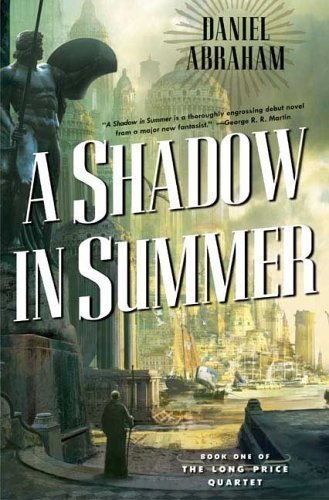
You can now pick up a cheap copy of Daniel Abraham's A Shadow in Summer on bookstore shelves.
I did not lust after this book with ravenous passion of a bel dame, but I did enjoy much of what he did with it. My review/rant is here.
Please support Series Fantasy That Doesn't Suck.